
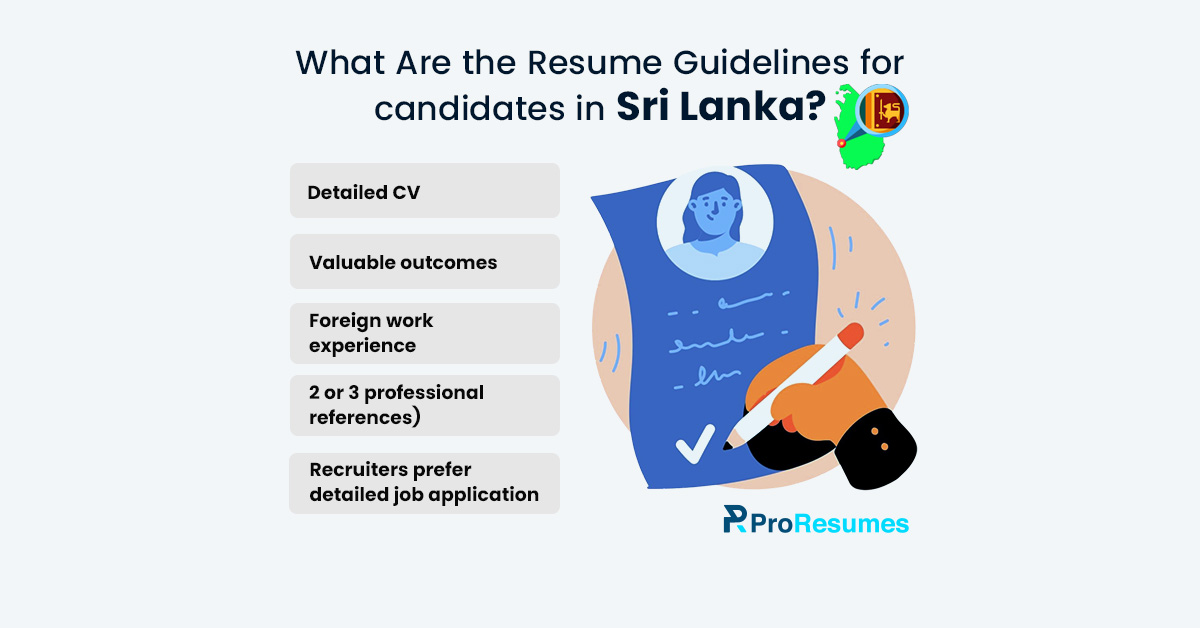
What Are the Resume Guidelines for candidates in Sri Lanka?
Are you planning to apply for a good job in the IT or tourism sector of Sri Lanka?
Learn about the resume standards in Asia that are essential to format your resume in 2026.
What is the document name used by the Sri Lankan population for a job application?
The Sri Lankan population mostly uses the word CV while referring to a job application or resume document. The word CV is an abbreviation of the Latin term curriculum vitae, which means the course of life.
The Latin word is used to refer to the resume document since it highlights a professional career journey. Moreover, some Sri Lankans also use the word biodata while referring to a job application. However, the documents that are known as biodata consist of more personal details of the applicant.
Regional resume standards for Sri Lanka in 2026
Sri Lanka is a country situated in the South Asian region of the world. Being a part of the Asian continent, the country follows various regional resume standards that differ from Western guidelines.
The following are some of the resume standards followed by Sri Lankan job candidates:
Resume Length
The typical length of a Sri Lankan resume document is between one to three A4 pages. However, according to the American or European resume standards, the resume length should not exceed a second page.
In Sri Lanka, many local recruiters prefer detailed CV or resume documents. Meanwhile, hiring managers from foreign-affiliated or multinational companies prefer concise job applications.
However, career experts suggest an easy way to decide the suitable resume length for a Sri Lankan document:
One-page resume: Candidates who are fresh graduates or those who want to change careers should use a one-page resume. The job applicants who don’t have five years of experience should never use more than one page for a resume.
Two- or Three-page resume: Mid-career professionals, managers, leaders, freelancers, or contract workers can utilize more than a single page. These applicants are allowed to use more resume pages since they have the relevant career details and experience.
According to career experts, job candidates with more than fifteen years of work experience should use two or three resume pages.
Paper Size
The resume paper is the first thing that generally comes into contact with a recruiter. However, candidates can go with many variations when it comes to color, layout, or paper material, except for the paper size.
Every country follows a specific paper size for professional documentation, including resumes, and job applicants have to follow it. The paper size that is utilized in Sri Lanka is A4, which is used by Asian and many Western countries.
The A4 paper size is part of the German paper series and is preferred by recruiters due to the following reasons:
- Easy to share
- Easy to scan
- Easy to access
- Easy to use
According to the A4 size standard, the dimensions used for the Sri Lankan resumes are the following:
- 8.27 x 11.69 inches
- 21 x 29.7 cm
- 210 x 297 mm
Resume Format
The most used Sri Lankan resume format is the reverse-chronological format, which is used by almost every country. It is also preferred by hiring managers because it clearly highlights the career progression of a job candidate.
Moreover, the reverse-chronological resume format is easy to analyze due to its structure. This resume format can be utilized for different types of candidates who have relevant work experience.
Meanwhile, many candidates in Sri Lanka also utilize other resume formats, such as the following:
- Functional resume: It is a skill-based resume format and is widely used by applicants who lack relevant expertise.
- Hybrid resume: This resume format is also known as the combination resume format and is mostly used by mid-career professionals. These professionals have the required skills and experience to highlight in their resume.
What are the main languages that are used by the residents of Sri Lanka for resumes?
The following is a list of languages used by the Sri Lankan job candidates:
Sinhala
It is one of the two official languages of Sri Lanka, with around sixteen million native speakers. It is one of the Indo-Aryan languages and is utilized for various professional and informal communication contexts.
Job seekers who want to apply for government positions or those that require local interaction should use the Sinhala language.
Tamil
Tamil is another official language of the country and is spoken by around five million citizens. It is a part of the Dravidian languages and is often used for resumes while applying to the following positions:
- Government role
- Public-facing role
- Dealing with locals
Pro Tip: Job candidates in Sri Lanka should always use the language of the job description for their primary resume language. If a job description is written in Sinhala, applicants should use it in their job application.
British English
English is used as a second language in the country and is used for various educational and professional purposes. The main version of English used in Sri Lanka is the Sri Lankan English (SLE).
This variety of English is derived from British English and is used in education, business, and other domains. However, the resumes in Sri Lanka utilize a standardized British version of English.
Job candidates should ensure the accuracy of the following language elements in their resumes:
- UK spellings
- Tone and style
- Grammar
Don’t know how to transition your Sinhala and Tamil resumes in the UK English version? Drop your worries and message ProResumes to get your resume critically reviewed or built from scratch by experts.
Is it significant to add the applicant’s picture to a Sri Lankan resume?
Yes, the Sri Lankan job applicants are required to add their picture specially while applying for local work positions. However, unlike the local industries and firms, foreign-affiliated companies or tech startups prefer a photo-less resume or a CV.
Moreover, applicants who are expected to add their photo should take care of the following guidelines:
- The resume picture should be in passport size.
- The applicant’s face should occupy 60% of the photograph.
- The applicants should avoid filters, weird angles, or selfies.
- The resume pictures should be shot professionally.
- The background of the picture should be decluttered and plain.
- The applicant should maintain warm and approachable expressions.
Are references a part of the resumes in Sri Lanka?
Yes, two or three professional references are often a part of the Sri Lankan resumes, especially when applying for local jobs. However, job candidates should confirm the recruiter’s requirements while preparing a resume to submit for a job at a multinational firm.
Moreover, the applicants who aren’t expected to add references directly to the resumes should prepare a references list. This list is mostly submitted later in the hiring process and includes details like:
- Full name of reference
- Occupation of the referee
- Contact details of referee (Phone number and email address)
- Relationship with the applicant
What are the key sections of the CVs or resumes in Sri Lanka?
The major parts of the Sri Lankan resume are the following:
Contact information
The first part includes details like the following:
- Full name
- Phone number
- Email address
- City of residence
- LinkedIn ID
- Website or Portfolio link
- Professional photo
However, the following are a list of personal details that should never be a part of your Sri Lankan resume:
- Age
- Marital status
- Religion
- National ID number
- Date of Birth
Professional summary
The professional summary is the elevator pitch and should be able to convince the recruiter to read the entire resume. It should be written in three to four lines while emphasizing the following elements:
- Main skills of the applicant
- Main achievement of the applicant
- Future aspiration of the applicant
- Years of experience in the industry
Work Experience
The work experience section starts with listing the most recent experience on top, followed by previous experiences. It includes the following details:
- Job Title
- Organization name
- Employment dates
- Work responsibilities
- Valuable outcomes
- Quantified achievements
- Foreign work experience
- Internships or apprenticeships
Education
The education section in a Sri Lankan resume is also formatted reverse-chronologically. It often lists the following details:
- Name of Degree or Diploma
- Name of the education institute
- Year of graduation
- Relevant coursework
- Academic honors
- Professional certifications
Additional Sections
The extra sections that can be included in the resumes in Sri Lanka are the following:
- References (2 or 3 professional references)
- Hobbies (Only mention relevant hobbies)
- Skills (Mention both technical and soft skills)
- Language proficiency (Fluency in Sinhala, English, and Tamil)
Formatting guidelines for resumes in Sri Lanka in 2026
Here’s a list of Guidelines that can be used by job applicants in Sri Lanka to optimize their job application:
- Avoid irrelevant imagery or graphics.
- Always use a plain and simple or one-column layout.
- Include keywords from job descriptions to optimize resumes.
- Emphasize educational credentials since they are valued by Sri Lankan recruiters.
- Emphasize your professional strengths in the resume.
- Avoid adding personal details that can lead to discrimination or bias.
- Always get the consent of your reference before sharing their details.
- Focus more on achievements over duties and quantify them.
- Use consistent and readable resume fonts.
- Always proofread your resume or get it reviewed by a friend or professor.
Want to plan your resume according to the resume standards in your region? Check out the resume guidance section on ProResumes.
| Resume Writing Standards | Checklist |
| Profile photo | Yes |
| Paper size | A4 |
| Spellings/ Language | UK English, Sinhala and Tamil |
| Resume Length | One to Three pages |
| Document name | CV, Curriculum Vitae or Biodata |
| Personal Data | No |
| Hobbies & Interests | Optional |
| Country-specific Trend | Recruiters prefer detailed job application documents |
| References | Yes |