
How to deal with Programmer imposter syndrome in the IT industry?
Ever felt that you’re not as good a software developer as everyone around you thinks?
Don’t worry, you’re not alone! 58% of tech workers suffer from imposter syndrome, as surveyed by Blind.
And you won’t believe it… Among these, fifty-eight percent of tech workers were employees of Big Tech firms like Google, Meta, Amazon, LinkedIn, and more.
That’s pretty much half of the tech industry being skeptical of their skills and experiencing imposter syndrome at different levels of their professional careers.
If you’re a young developer just starting out or a senior software engineer who is promoted to a really cool position but experiencing this syndrome, don’t panic!
It’s natural.
In this article, we will shed light on programmer imposter syndrome, its causes and symptoms, and a practical set of tips to help you deal with it while being in the tech industry.
What is imposter syndrome in programmers?
Imposter syndrome, in its true sense, is the psychological condition where one doesn’t find themselves capable enough of a position, a reward, or recognition.
People experiencing imposter syndrome are always experiencing a sense of fear of getting exposed as an imposter or someone who is fake.
Even though sometimes they have clear evidence of their competence, they have this sinking feeling that they aren’t what others think about them.
Programmer imposter syndrome is understandable when they are dealing with an industry that is evolving every second and demands creativity and a higher level of analytical thinking to survive in it.
Programmers who experience this syndrome are in a state of constant self-doubt, fear of appearing as a fake, and constantly comparing their progress with other members of the team.
According to a Quora user, the syndrome is more like having a feeling of awareness that you need to gain knowledge and learn more in order to solve a problem that feels too foreign.

It’s always that little feeling in your gut that makes you think that people are going to find out that you’re not as capable as you appear in front of them.
But hold up, you’ve to acknowledge the fact that you’re a part of a vast industry that has so much to explore, such as a range of programming languages, modern frameworks, and libraries.
Programmer imposter syndrome is inevitable if you’ve to learn how to manage databases, to understand software architecture, and to shift traditional systems to the cloud infrastructure.
It’s more about learning better than questioning whether you deserve to stand in the place you happen to be in today!
Why is imposter syndrome so common in tech?
The tech industry is a field that is prone to developing programmer imposter syndrome, thanks to its ever-changing landscape with a mixture of pressure, competition, and the emergence of Artificial Intelligence (AI) technology.
Ever-changing IT industry
With technology evolving every second, even the most competent employees feel like they cannot keep up with too much to learn and fall prey to the programmer imposter syndrome.
Complex projects
Developers are always involved in working with high-stakes projects that demand too much time, money, and knowledge, so they fear making blunders that can cost them big time.
Dunning-Kruger effect
There is a learning paradox: that the more you learn, the more you get aware of the fact that there is still so much to learn. In contrast, there are also people who think that they know a lot more than they actually know. This often impacts the mindset of developers and makes them feel incompetent at times.
Increased Competition
Since the tech industry culture is all about technology and advancement, comparisons with peers are quite inevitable, resulting in programmers’ imposter syndrome for most.
The emergence of AI
With the emergence of AI tools and automation of so many jobs, developers feel that they can be easily replaced and hence struggle to do more than they are actually expected of leading to burnout and experiencing the syndrome.
If you’re struggling with software developer burnout, do check out the tips on how to recover fast from it. (INSERT LINK of BURNOUT ARTICLE)
How do normal people with imposter syndrome act?
Signs of imposter syndrome
- You always feel that your abilities are inadequate for the job.
- You face extreme fear of getting exposed as someone who is a fraud.
- You always compare your own progress with the rest of your teammates.
- You feel like you were not meant to pursue this career path.
- You avoid communicating with other teammates in fear of exposing the gaps in your own learning.
Programmer imposter syndrome might be persisting in your mindset and beliefs if you feel like observing these signs in yourself.
How do you overcome imposter syndrome in tech?
Accept it
Accepting the issue is the first step you can take towards mitigating it. Programmer imposter syndrome is real and common when it’s concerned with the tech industry.
Don’t compare yourself to others
You can’t mitigate a problem if you look at it with negative emotions. That’s why, to avoid being an imposter as a software developer, it is important to stop comparing yourself with others.
Seek help
If you don’t know anything, seek help from senior developers, team leaders or managers rather than stagnating your brain. Mentorship for software developers can be an ideal step in mitigating Programmer imposter syndrome.
Don’t give up
You need to work on your belief systems and stop with the self-sabotaging behaviors. Develop a growth mindset that sees every failure as a chance to learn better.
Focus on the journey instead of the destination
Focusing on progress sometimes gives you dopamine hits and throws you into a developer’s anxiety the other times. It’s more important to focus on the process rather than the results.
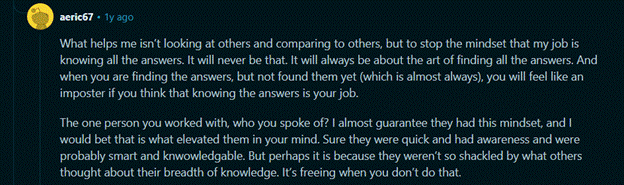
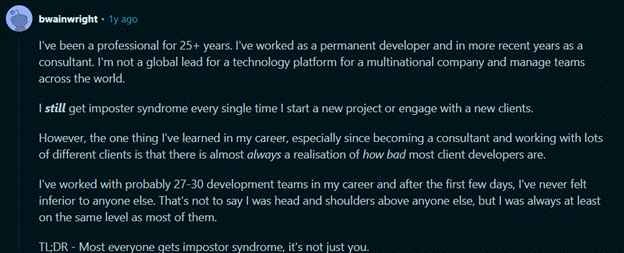
According to these Reddit users, programmer imposter syndrome can be dealt with through more learning, experience, and mindset shifts.
What are the 5 p’s of imposter syndrome, and how do they relate to programmers?
Perfectionists
These people suffer from programmer imposter syndrome because they are unable to get fully satisfied with their work and receive help from others.
Experts
They want to know every single thing before working on a project, otherwise they feel incompetent while working on it.
Supermen or Superwomen
Such developers are often very hard on themselves since they think of themselves in high regard, often falling prey to the programmer imposter syndrome.
Natural Geniuses
Since they are naturally good at things, it makes them feel fake when they have to strive harder to get something related to work.
The Soloist
Such developers prefer working all by themselves since they consider asking for help as a sign of their inadequacy.
If you are currently experiencing this syndrome and thinking that your resume as a software developer doesn’t stand a chance. Check out Proresume.io resume writing services and get the job you deserve!
Programmer imposter syndrome is natural (You’re not alone)
To sum up the entire discussion, programmer imposter syndrome isn’t a foreign feeling; it’s very inevitable while working in a competitive industry.
Remember, it’s not about having all the answers but looking for them!
Frequently Asked Questions
Q. What is the other name for imposter syndrome?
Imposter syndrome is a psychological phenomenon which is also known by the names Imposter phenomenon, Imposterism, perceived fraudulence, and fraud syndrome. It is the condition where one is highly skeptical of their competence in a particular thing, even though there is evidence of it.
Q. What is the root cause of imposter syndrome?
Even when there is no definite single cause of this syndrome, however, there are multiple factors that can cause imposter syndrome, such as family dynamics, competition with peers, unnecessary social media exposure, and more.
Q. How to identify imposter syndrome?
There are several factors to identify if one is experiencing imposter syndrome, including experiencing extreme fear of getting exposed as a fraud, being a perfectionist, and overworking oneself to the extent that one gets burnout, and being in a constant phase of self-doubt.
Q. Do highly intelligent people have imposter syndrome?
Yes, imposter syndrome is more common in highly intelligent people and those who are high achievers. These people generally experience this syndrome because they have higher expectations of themselves. They avoid giving credit to themselves, and the more they are exposed to something new, the more they experience this syndrome.