
Federal Resume vs. Standard Resume for Career Success
Resume writing standards depend on the industry, job title, and sector you are applying for. A generic resume for different job titles, industries, or sectors can’t generate optimal results in today’s competitive job search market. Federal resume writing standards are changing. Before applying for any job in 2026, you should go through the latest trends.
A customized, ATS-friendly resume is key to success for federal, semi-government, and private sector jobs. According to resume-writing industry experts, there are various types of industrial resumes, including Federal Resume, Standard Resume, Academic Resume, Military-to-Civilian Resume, and Curriculum Vitae (CV).
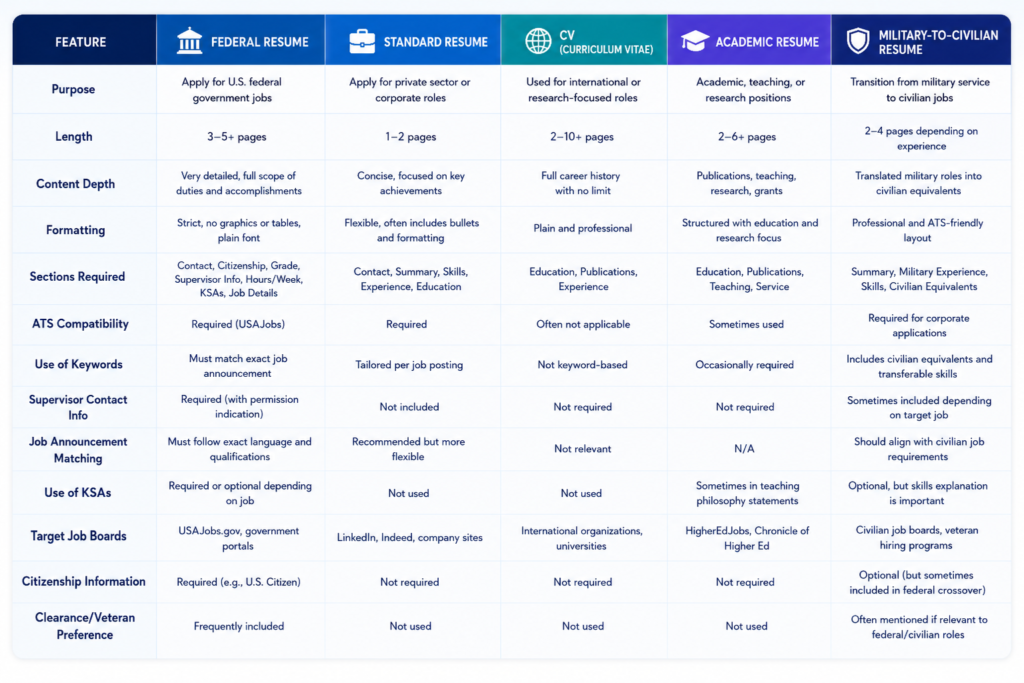
Mastering the art of creating and optimizing resumes for different sectors has become a daunting task without knowing the major differences between all these types of resumes. If you are not receiving interview calls for federal jobs, you may be using the wrong resume for a government job application.
What are Standard and Federal Resumes?
A federal resume is a specialized document with authentic information when applying for USAJOBS jobs. A candidate applying for federal jobs will follow the government application process and will apply directly to the USAJOBS portal for the job announcement. The job announcements contain important information about application procedures, including any special resume formatting requirements, the specific responsibilities of the targeted vacancy, and the qualifications an applicant should possess.
On the other hand, a standard resume is used for the civilian sector. A job seeker applies to portals where a job is listed, such as LinkedIn, Indeed, a company website, etc. To get an interview call in the private sector, your resume should be ATS-optimized, as 98% of high-tier companies leverage applicant tracking systems for recruitment.
Pro News: The introduction of “Schedule G” by President Donald Trump has initiated the new policy debate in the U.S. federal employment system.
Top 7 Key Differences Between Federal and Standard Resumes
The resume strategy and recruitment for both resume categories are 110% different. If you are applying for government jobs with a standard resume, you will never receive a response from the hiring agency. Federal resumes must include specific information required by the application process to ensure that the client can be assured of the same level of consideration. Just like with standard resumes, it’s vital to customize the resume based on the job postings provided.
- Resume Contact Information
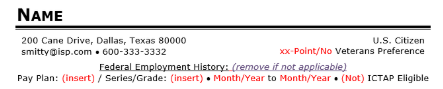
Contact information such as Your Legal Name (avoid nicknames), Email, Home Address, and LinkedIn URL is common in both standard and federal resumes. But federal resume demands more personal and professional information at the top of the document, such as Nationality, Veterans Preference Points, Employee ID (of previous government job), Highest Grade Held, and Clearance.
- Resume Format & Layout
Both should be chronological resumes, following the basic resume writing standard in terms of formatting. When it comes to federal resume formatting, it should be in black and white paper with a simple font. There should be no graphical elements, tables, or columns that make the content crowded or visually uneven.
ProTip: A federal resume should follow a strict, highly detailed format.
- KSAs
Knowledge, Skills, and Abilities (KSAs) statement is sometimes required as a separate document for the federal job application. The civilian sectors don’t ask for KSAs, and they demand a cover letter. Reading job posting information is necessary for both sectors. You need to update documents per the requirements mentioned in the job announcement for the government application.
ProTip: Don’t know what KSAs are or how to write them? Read ProResumes’ complete guide on KSAs vs. Cover Letters to stand out in 2025’s complex job market.
- Resume Length
There is no 1-2 page resume length limit for a federal resume. It can be 4-6 pages long as compared to the civilian job resume. The resume length for federal jobs doesn’t matter, but the coverage of information mentioned in the job announcement is the game-changer in securing an interview call.
- Resume Content for Federal vs Private
The entire content in the federal resume should be written following the STAR method and should reflect requirements or wording mentioned in the job announcement. Just adding keywords in a federal resume like standard will not produce the results you are looking for.
- Professional Experience
The professional experience section of a federal resume requires more information than Job Title, Company Name, and Location. You should add Working Hours, Supervisor Name, and Number for each job. Experts recommend adding relevant skills against each role instead of making a separate section for “Areas of Expertise.”

- Job Announcement Matching
Your federal resume must closely match the job announcement. You can cover job requirements in the professional summary, professional experience, and related skills.
What Should You Include and Avoid in a Federal Resume?
A resume and its parts or sections for a federal job are different than one for the civilian sector. You must add each skill and qualification mentioned in the announcement, clearly and without jargon. You should avoid adding government-sensitive information, any type of photos, personal information, such as age, sex, religious affiliation, Social Security Number (SSN), and encrypted and digitally signed documents.
How does the Hiring Agency Process Federal Job Applications?
- Create and maintain an account with login.gov
- Manage a USAJOBS profile
- Search for Jobs
- Save Your Search
- Review Job Announcement
- Prepare Your Application in USAJOBS
- Submit Your Application to the Agency
- Agency Reviews Application
- Interview
- Agency Selects Candidate
- Job Offer
Moreover, there is a feature in the USAJOBS portal called resume and profile searchable for recruiters. You can turn that “On” to help recruiters find you as the best fit for their role.
ProTip: For step-by-step guidelines on the job application process, you can visit the official USAJOBS website.
Impacts of Schedule G on federal hiring
To acknowledge Government administration with some positions based on their confidential, policy-determining, policy-making, or policy-advocating character, Donald Trump has initiated “Schedule G.” This will increase the competition among federal job hunters, or maybe this will fill all the open jobs without announcement.
Conclusion
The federal resume is completely different from a standard resume. Your resume strategy, including content, formatting, and application submission, should meet the expectations of each sector to increase your chances of securing interviews. Applying for a job with the US Federal government is a unique process. Unlike state and local levels of government, there is a fair degree of consistency and standardization across the entire process.