
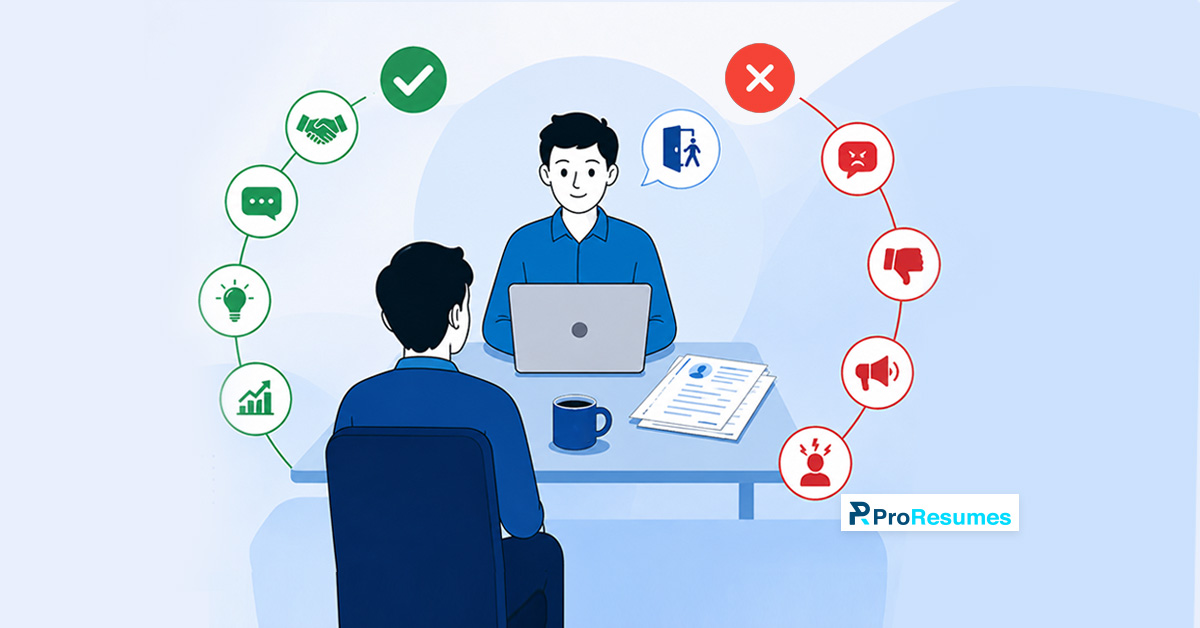
What to Do and Avoid during an Exit Interview?
When an employee voluntarily resigns from a job, they are often invited for an exit interview with the HR manager. While this interview isn’t a mandatory meeting, it focuses on collecting insights regarding company culture and employee experience.
Are you getting nervous about this official meeting? Don’t worry; explore the tips for departure interview preparation along with common interview questions. Moreover, check out the things you shouldn’t say during this interview.
Not getting any interview calls? Get a manual and automated resume review to ensure the compatibility of your resume/CV with applicant tracking systems (ATS).
What is an exit interview? (Why is it important?)
An exit interview or written survey is conducted by organizations to analyze the reason for employee turnover. These interviews are mostly conducted by the HR department or an employee’s direct supervisor. The employees are invited for this departure interview after their resignation or offboarding.
Moreover, not all organizations invest in such interviews, except those that want to gain employee insight and enhance job satisfaction. They mostly ask questions regarding why an employee wants to leave, what processes need improvement, and what the company culture is.
When companies conduct a range of these interviews, they can easily analyze the metrics to build better strategies for future employees. Moreover, it is a good chance for professionals to provide feedback that can help others in the future. The reasons for leaving and job satisfaction rate impact the HR policies and overall work culture of the organization.
Why does the Human Resources (HR) department conduct exit interviews?
The human resource management department is involved in conducting the off-boarding interview with the departing employees. They use this interview as a chance to get actionable insights for the company to retain good employees.
Here’s what HR does after getting the responses of an employee:
- They evaluate management practices.
- They identify the gaps or main areas of improvement.
- They implement various employee retention strategies.
- They analyze the turnover trends by evaluating various employee departure interviews.
How to prepare for an exit interview?
If you have a departure interview coming soon, read and utilize the following tips to make it beneficial:
Prepare yourself
You should prepare for this interview like any other job interview. Moreover, it is best to research common exit interview questions and prepare your responses to avoid any issues.
Find the frequently used interview questions like you would research culture-fit, competency-based, or more. Moreover, utilize a mock interview session with a friend to analyze your responses.
Pro Tip: You can also record your mock interview practice to check whether your responses are positive. It is best to keep your responses diplomatic.
Focus on facts
You should not share deeply subjective responses to the employer’s questions. HR managers prefer answers that can share actionable insights to make the company policies better.
You can share the main reasons for leaving, like having more job security and benefits. HR professionals love when the departing employees stick to the facts. They don’t value emotional language, personal complaints, or negative remarks during the exit interview.
Remain positive
It is best to stay positive during such an interview despite how you feel about the organization, colleagues, or company culture. When employees are too emotional or critical about things, their opinions are not valued.
Meanwhile, you should share what you loved the best or what you gained during your time at an organization. However, you should be respectful while providing workplace culture feedback.
Pro Tip: HR conducts departure interviews to learn from the departing employee. The responses should be objective in nature and linked with examples of professional experiences.
Decide a reason for leaving
The most frequent question that you will hear at most employee off-boarding interviews is, “Why are you leaving?” You should be honest while answering this question with a good reason for leaving the job.
However, if you have to give up on the job due to personal reasons, don’t go into detail. You can simply state that you have other priorities. Moreover, if you’re leaving because you have got another job offer, avoid bragging about it.
Offer recommendations
More than anything else, it is an opportunity to provide workplace culture feedback to suggest improvement. You should offer suggestions in a positive way for improvement in the following areas:
- Communication modes/formats
- Processes, workflows, company systems
- Management strategies
- Employee training and professional development
- Work-life balance
- Organizational culture
- Team dynamics and collaboration
- Employee recognition
Stay professional
The departing employee should show their professionalism during an exit interview to avoid burning bridges. You should be careful and not say anything that you don’t want a future employer to know about you.
Moreover, avoid speaking negatively about the staff, colleagues, or any supervisors during your offboarding interview.
6 common exit interview questions and tips to answer them
Many organizations utilize different policies for employee off-boarding and exit interviews. However, the following is a list of interview questions that are asked by every HR manager:
Why did you start looking for another job?
You should be very honest while answering this exit survey or interview question. This will help the organization in refining their business policies and making changes to managerial roles for better talent retention.
Why are you leaving this organization?
This is the most asked question during a departure interview with a professional. This helps the HR managers analyze the source of the problem that leads to the employee’s resignation.
Can you describe your overall experience while working at this organization?
Your answer will offer insights into company culture or work processes that require improvement. You can share issues with time management, excessive workload, or the lack of professional development.
It is best to avoid entirely negative elements and focus on the positive aspects as well. This approach will allow you to give a balanced answer to this exit interview question.
How would you describe the culture of our company?
HR professionals often ask these or similar questions to analyze trends or to get actionable insights. These insights help in separating genuine concerns and problems from personal opinions.
The departing employee can share their experiences regarding company culture or teamwork issues with the HR professionals. This will help them create better policies to refine the company’s culture.
Did you feel that your career goals and professional development were prioritized here?
Many companies invest in employee professional development to retain them for a longer period. Through this question, they ask your views on their efforts regarding this matter.
However, the answer of the departing employees should be balanced as well as constructive.
What can we do for you to remain employed at this organization?
When HR professionals use this question, they want the employee to open up their main concern. The response is utilized to change systems or workflows for better employee productivity and retention.
For example: An employee shares that they are looking for a hybrid or remote work position. The HR department conducts a survey and asks the rest of the employees whether this can enhance their productivity levels as well.
Pro Tip: If you don’t want to answer an exit interview question, then you can politely decline it. Since these interviews are not mandatory, you aren’t obliged to answer every question.
What not to say in an exit interview?
The way you respond to the questions of the HR professional during the exit survey or interview can affect your career. Employees should focus on being careful while dealing with the human resource management team before leaving the organization.
Apart from learning the things you should say, here’s a list of things that you should avoid:
“My direct supervisor/manager is very toxic.”
Even if you’re leaving because of a toxic manager or environment, you should still show professionalism. Since it can burn bridges and impact your future career prospects as well.
Most of the time, when employees appear for the off-boarding interview, they say negative things about the company. Since they don’t plan to return there in the near future.
However, it can impact your career since new employers demand recommendations and reference letters from your previous workplace. Moreover, you may find a past supervisor or employee at the new organization.
Remember to keep your answers positive and provide constructive criticism. This will help you deal with an exit interview in a toxic workplace environment
“I’m not getting paid enough.”
The majority of employees leave the workplace because of the lack of monetary compensation. However, salary shouldn’t be utilized as the sole reason for leaving the organization or work position.
Such a reason can give the employer the idea that the departing employee only cared about money. Avoiding such statements in an exit or departure interview is the best way to leave on a positive note.
Expert advice: It is best not to disclose the salary and job benefits you will get from another organization during the off-boarding interview.
“My teammates want to leave the organization.”
You should never speak on behalf of your teammates since it can backfire during an exit interview. The departing employee should show professionalism and avoid such discussions during the departure interview.
Instead, you should focus on giving actionable insights that can help enhance talent retention strategies.
“Let me share what’s wrong with this organization…”
You should avoid giving suggestions like this when you’ve already chosen to leave. Moreover, avoid rambling or venting all the issues you had with the direct supervisor or workplace culture.
It can easily backfire and frame you as a problem instead of the organization, colleagues, or the culture. Moreover, it can easily eliminate one’s chances of getting rehired by the same organization in the future.
“I can’t work easily with low resources.”
You cannot complain about everything since it will imply that you’re picky and very hard to please. Even if the resources and their quality impact your performance, offer a broader level of constructive feedback.
This will help employers focus on talent retention by improving productivity with better resources. Being positive while sharing feedback helps in winning points with a former employer.
What are the best practices for exit interviews in 2026?
The best way to answer the departure interview questions is to have a positive mindset and be honest. Here’s a list of exit interview tips for departing employees:
- The employees should only provide details that they are comfortable with.
- They can create a checklist while interview preparation to cover important details.
- The departing employee should avoid being confrontational during the departure interview.
- The employee should share realistic insights.
- They should be positive and honest while giving each response.
- They should avoid blaming supervisors or colleagues for any problems.
Key Takeaways
- An exit interview is a meeting between HR or the direct supervisor and the departing employee to gain insight about the employee’s experience.
- Exit interviews help in refining HR policies, changing managerial positions, and increasing employee retention and job satisfaction rates.
- The most common interview questions cover reasons for leaving and the overall experience of the employee at the organization.
- The departing employee should show professionalism and a positive attitude during this interview and provide constructive feedback.
Frequently Asked Questions
Q. Can you decline an exit interview?
The exit interview isn’t mandatory, and a candidate can politely decline it if they are not comfortable. However, it is a chance to offer workplace culture feedback to help the organization evolve for future employees.
Moreover, here’s a list of tips to decline this interview easily:
- You can send a quick email or politely talk with your direct manager or HR team to cancel the meeting. The point is to keep your message concise.
- The departing employee should be professional and shouldn’t use any negative remarks.
- Ask for an online survey or exit form instead of an in-person interview to provide feedback on corporate culture.
- There is no need to feel pressured to appear for such an interview even when invited by senior staff members. Declining it doesn’t affect your references or experience on the resume.
Q. What are the good reasons for leaving a job?
When it comes to exit interviews, HR professionals or hiring managers often ask employees for the reason they’re leaving. However, it is important to be prepared for such a question and aware of your reason for leaving.
Here’s a list of some good reasons that you can give for your resignation from a work position:
- You want to transition to another industry.
- You are aiming for professional growth.
- You need a better work-life balance.
- You want remote or hybrid roles.
- The company culture isn’t the right fit for you.
- You didn’t feel challenged in your current position.
- You want to go back to school or learn more skills.
Q. How long does an exit interview last?
These interviews are mostly conducted by HR professionals and last between 10 and 90 minutes. The time frame of an HR exit interview or an exit survey for employees depends on the following factors:
- The organization’s structure. (small-scale or large enterprise)
- The interview format (Sometimes, the employees are given a form to fill in their responses. Meanwhile, some have a phone interview to share their constructive feedback. Moreover, some departing employees are asked to attend an in-person meeting with the HR department before or after their last day.
- Interview questions and what the organization wants from the departing employee.
- The information an employee wants to share with the organization.
- The complexity of the constructive feedback shared by a departing employee.
Q. What is the difference between a stay interview and an exit interview?
A stay interview focuses on employee retention and is known as a structured meeting between an employee and a direct manager. It is considered a preventive measure and analyzes facts that can either keep one engaged or lead to leaving.
It is utilized to analyze workplace feedback and job satisfaction while a person is still employed. The stay interview helps in motivating the employee to stay and also helps build strategies to prevent employee turnover.
Meanwhile, the exit interview is a diagnostic meeting between HR and the departing employee. It collects actionable insights from the constructive feedback of the candidate who wants to leave.
It helps assess an employee’s experience (EX) but can’t stop their departure from the organization.