
Competency-based interview: Definition, Questions & Tips
Competency-based interviews are utilized by employers to identify your skills through your past work experiences. To achieve well in a competency scoring rubric, candidates should use the STAR framework and provide relevant examples for each competency.
Want to get some competency interview tips to crack your upcoming interview? Explore this interview preparation guide for job seekers with competency-based questions, dos, and don’ts.
What is a competency-based interview?
A competency-based interview predicts how well a candidate performs in a role by evaluating one’s past experiences. Employers use these interviews and ask questions that focus on key competencies, including communication and analytical thinking.
These interviews are used for skills-based hiring where candidates are expected to share past experiences through structured answers. The candidates focus on linking their experiences with the recruiter’s requirements for the target role.
The competency-based interviews typically last for an hour for many candidates. Moreover, employers use three to four situational questions to evaluate one’s transferable skills.
What are the common competencies assessed in a structured interview?
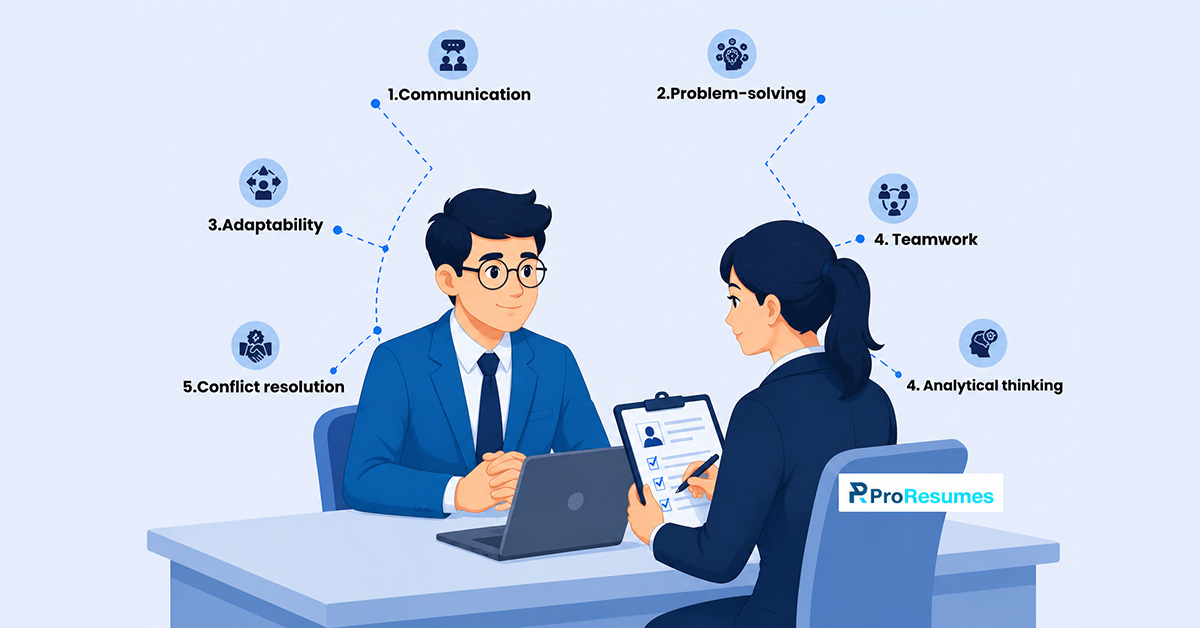
The competencies that you should focus on mostly depend on the target role and the company’s requirements. However, here’s a list of core competencies that are required by hiring managers and organizations:
Communication
Strong communication skills, especially interpersonal communication, are required for almost every role. Organizations look for this soft skill in candidates by asking situational questions that require structured responses.
Industries that offer client-facing roles focus on strong communication as a key competency in the ideal candidate. These roles require clear verbal and written communication skills.
Problem-solving
It is a critical competency that is required for every role and industry. Professionals need to work on their problem-solving skills if they want to grow in their career.
When employers ask interview questions related to problem-solving, they want to see leadership potential in candidates. This performance-based hiring helps in finding candidates who aren’t a cultural fit, but those who can add to a company’s culture.
Adaptability
Adapting to changing situations and evolution is important for professionals who want to grow. This flexibility helps the candidates adjust to new workplaces, responsibilities, performance indicators, and organizational policies or goals.
Teamwork
Organizations are built on different departments and teams of professionals. This is why employers look for candidates who are good at teamwork during group interviews. They use structured interview questions to analyze if the candidate is a good team fit.
Moreover, interviewers use questions that detect the following skills in a candidate to identify their teamwork ability:
- Empathy
- Negotiation
- Communication
Conflict resolution
Employers look for candidates who can handle workplace conflicts calmly. The workplace depends on professionals with varied work styles and environment preferences, which can cause conflicts.
During competency-based interviews, the recruiter asks behavioral questions to analyze how well one can resolve conflicts. They also analyze whether the candidates have active listening and negotiation skills that are required for conflict resolution.
Time management
Interviewers look for this key competency to evaluate organizational and management skills. Moreover, they use competency-based interview questions that help them analyze whether one is productive and focused.
Resilience
Workplace situations can sometimes become stressful for employees and can cause severe issues for them. Interviewers use situational questions to evaluate how resilient they are and how well they manage stress.
They ask for experiences like tight deadlines, busy schedules, and more to analyze their coping mechanisms. The candidates who appear to be more resilient are better at focus and work performance.
Analytical thinking
It is also among the core competencies that hiring managers look for during a situational interview. The candidates who are analytical thinkers demonstrate great observation, interpretation, and research skills to solve issues.
The competency interview questions for leadership roles are used to evaluate a candidate’s critical thinking skills.
Emotional intelligence
The hiring managers often look for emotional intelligence competency in job applicants. A positive company culture relies on professionals who are good at negotiation, conflict management, and self-evaluation.
Employers highly consider candidates who are aware of their emotions and don’t channel them in a negative way. These individuals are important to maintain collaborative relationships among professionals in a team.
Do you know how to embed these competencies effectively in your resume content? Connect with ProResumes and get a professional resume document that will increase your job interview opportunities.
How to use the STAR method for competency-based interview questions?
If you want to crack the competency-based interview questions, utilize the STAR framework for your responses. It consists of the following elements that help in giving a structure to the interviewee’s answers:
Situation
This includes 10 percent of your answer and focuses on a situation where you faced a problem at work. It shares the background details and should not consist of more than two lines.
Task
This section also comprises another 10 percent of the answer and addresses the main responsibilities of the candidate.
Action
This is the most important part and should have 60% of your answer for a competency-based interview question. The candidates should focus on their main achievements and how they dealt with the main task or problem.
Result & Reflection
This component of the STAR framework should possess the remaining 20% of your answer. It focuses on the positive aspects of the actions that you took. The reflection component is a bonus part that should highlight a candidate’s learning due to the particular experience.
How to prepare for a competency-based interview in 2026?
Here’s a list of steps that you should follow to pass a capability-based assessment or interview:
Analyze the job description
To understand the key competencies required for the role, candidates should analyze the job description. This helps them understand the work context and their core responsibilities.
Some organizations provide a structured description for job seekers instead of generic ones. After collecting the main competencies, the candidate should filter out the ones that they are proficient at.
Research the company
Company research is an important part of job interview preparation and helps the candidate with many aspects. However, this is a very important part that candidates should never skip for competency-based interviews.
This helps the candidates in predicting the competencies required by the employer through analyzing the following:
- Company culture
- Company goals
- Mission and vision statement
- Products/services
Pro Tip: This also helps the interviewee in demonstrating genuine interest in the company and the target role.
Collect some past examples
This structured interview technique is used to predict future outcomes through past performance indicators. This step requires a little effort from the candidate’s side since they need to collect past work examples.
These examples should be clearly linked with every competency that the candidate wants to target. You should pick examples of learning experiences and situations along with quantifiable achievements.
The candidates can list 5-6 examples with every competency in the notebook that they will bring to the interview. In their notes, they can also add the following things for better structured responses:
- Main problems
- Responsibilities
- Actions
- Facts
- Dates
- Numbers
Pro Tip: Create a mind map for each competency separately and list all important and relevant past experiences with it.
Link experiences with competencies
After listing all the examples, observe each competency utilized in the example and link them. Sometimes, an example of past experience can be used to answer a question for two or more competencies.
However, candidates should avoid using a single example or experience for answering multiple competency-based interview questions. If the situation was challenging, it can be used for answering multiple questions.
Rehearse your answers
During this stage, you need to focus on mock interview practice and rehearse your answers to perform well. Job seekers can follow this interview preparation guideline by using a friend to listen to their answers.
Moreover, recording oneself helps in properly structuring answers with the STAR method. It also helps with time management. Moreover, use a two-minute timer to deliver a STAR answer, which usually lasts for 1 or 2 minutes.
Pro Tip: Rehearse your answers to learn time management and answer-structuring instead of being robotic during the interview.
What are some common competency-based interview questions?
The following is a list of frequently utilized competency-based interview questions for your preparation:
- Describe a situation when you were expected to overcome a hurdle.
- Share a time when you had to adapt and master a new skill to fulfill your responsibility.
- Tell me about a work project where you utilized creativity to find innovative solutions.
- Tell me about the time when you contributed to the betterment of your workplace.
- Share a situation where you were under pressure and were required to perform well.
- Tell me about a time when you offered structured feedback for a teammate.
- Share a time when your ideas helped in enhancing the company culture.
- Have you ever dealt with a workplace conflict?
- Tell me about a time when you learned something unexpected.
- Give an example of a time when you had to simplify a complex idea for someone with zero expertise in your area.
What to focus on and avoid while giving a competency-based interview?
If you want a good hiring manager evaluation score for competency-based interviews, then you should focus on each required competency.
Here’s a list of some dos and don’ts that you should be aware of before appearing for a virtual or onsite interview:
Dos of competency-based interview
- Always listen attentively to the interviewer’s question before giving your answer.
- Ask your friends or acquaintances for some structured feedback on your key skills.
- Observe the body language of the recruiter or HR professionals to evaluate your interview performance.
- Share the lessons you learned from a situation for at least 2 questions in a behavioral interview.
- Use “I” instead of “We” to highlight your contribution to a team-related situation.
- Candidates should vary their tone and pitch while answering a competency-based interview question to maintain interest.
Don’ts of competency-based interview
- Present any false or made-up work experiences while answering behavioral questions.
- Lie during a competency-based interview since it can be risky.
- Give generic answers to situational questions instead of using the STAR method.
- Ramble random stories instead of providing relevant details of an experience.
Is AI competency screening better than competency-based interviews?
When it comes to competency-based interviews conducted by human recruiters, decision-making might be influenced by affinity bias. Human interviewers sometimes can’t predict the real performance indicators and hire people based on cultural alignment.
Meanwhile, AI screening eliminates this bias and is often more accurate at mechanical tasks. This is why applicant tracking systems (ATS) software filter thousands of applications in seconds on the basis of industry-specific keywords.

However, AI is not as good at contextual tasks and can make mistakes when it is used to analyze human behavior. The virtual interviews that involve AI interview screening for eye movements and other non-verbal behaviors aren’t successful.
The AI agent flags a candidate as underqualified if they have poor body language instead of evaluating their expertise. Even when human interviewers are vulnerable to being biased, they are still better at evaluating behavioral performance than AI screeners.
Key Takeaways
- Competency-based interviews focus on behavioral indicators to predict how a candidate will perform in a role.
- Core competencies include time management, emotional intelligence, communication, adaptability, and resilience.
- Candidates should use the STAR framework to answer competency-based interview questions.
Frequently Asked Questions
Q. What if I don’t have a perfect real-life example to share?
Most candidates worry about not having good real-life work examples or past experiences to share in such interviews. However, using a fake story to answer a performance-based interview question can be quite risky.
Recruiters often use follow-up questions to learn more about quantifiable achievements and can easily detect a lie. If you’re a fresh graduate or beginner with zero work experience, think beyond professional expertise.
The candidates can easily recall experiences linked to academics, internships, or volunteering. They can use these experiences to show transferable skills and clear the structured interview.
Q. What is the difference between a traditional interview and a competency-based interview?
Traditional or general interviews are different from competency-based or skills-based interviews. Traditional interviews usually focus on the current capabilities of the candidate and how they can help the company in the future.
These unstructured interviews focus on interview questions that revolve around professional and academic history or the personality of a job candidate. The employers want to know the opinions of a professional and how well they know about their organization.
They often ask the following types of questions during the interview:
- Tell us about yourself.
- Why should we hire you?
- What can you bring to the role?
Meanwhile, competency or performance-based interviews assess whether candidates have the core competencies that the company requires. These interviews focus on past performance indicators to predict how they will perform in similar situations.
However, the candidates can’t pass a competency-based interview unless they present structured answers. The interviewers want the candidates to share the real stories where they solved issues with their key competencies.
In such interviews, the hiring manager focuses on probing the candidate and asking follow-up questions to learn more about an experience. Through these criteria, the interviewers want to analyze whether the candidate understands the nature of the job or not.
Q. What does a ‘poor’ vs ‘excellent’ competency score look like?
The interview rating scale that is utilized to score the answers to the behavioral interview questions has 5 scoring options. This interview evaluation criteria is a bit more structured to compare easily among candidates.
Here’s a list of all the competency scores and what they mean:
- Far exceeds requirements: This is known as an excellent competency score, and the interviewer agrees that the candidate has given a perfect answer. This means that they have shared all the relevant points and examples in it.
- Exceeds requirements: This scoring criterion means that the candidate has shared good examples and explained the competency consistently. However, their answers still cover all the requirements of the interviewer.
- Meets requirements: According to this scoring criterion, the interviewer agrees that a candidate can apply the competency where required. However, they might need guidance from someone with more expertise to do a better job.
- Below requirements: This means that the answer of the interviewee is not according to the expectations of the recruiter. It means that the past performance indicators of the candidate weren’t up to the requirements for the role.
- Significant gap: This is a poor competency score for the answer of a candidate who does not possess the required core competencies. This happens when the answer of a candidate isn’t structured and lacks relevant details or good examples.
Q. How to talk about failure in a competency interview?
The interviewer often asks about a situation where you failed and how you handled it in competency interviews. However, the candidates should never answer this question with, “I’ve never failed!” Since it is an instant interview killer and gives the impression that a candidate lacks self-awareness.
Instead of unstructured answers, the candidates should use the STAR framework to share a failure. The candidates can utilize the following tips to answer:
- Pick a failure that contributes to your professional growth.
- Share the lessons you have learned and how they contributed to your growth.
- Don’t put the blame for your failure on others and show accountability.
- Instead of dwelling on the negative side, focus on what you actually gained.