
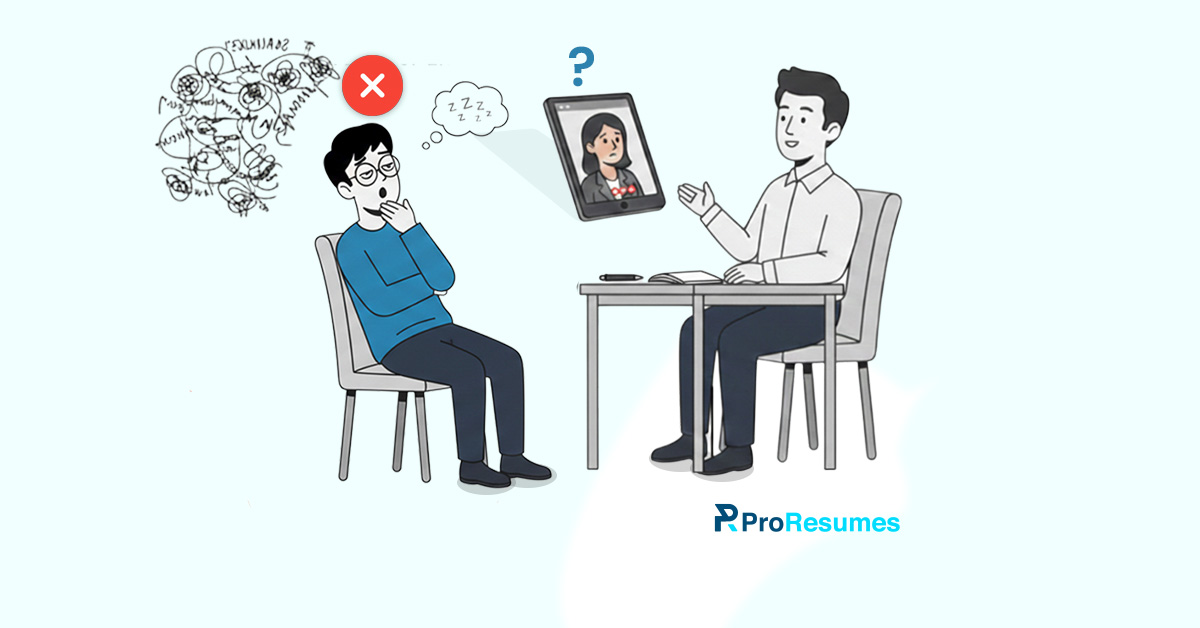
Alarming interview red flags that you shouldn’t ignore!
Did you ever come across an interview candidate who kept looking at their phone and bluffing about their expertise?
Well, these are interview red flags, and you should be able to notice them as a recruiter. The HR professionals of any organization are tasked with interviewing and hiring the best candidate.
However, most hiring managers shared their interviewing experiences and how they dodged a bullet by picking up on the signs.
Moreover, if you’re a candidate who is expecting an interview in the coming days, avoid such red flags.
In this guide, we will share 15 alarming interview red flags for employers. We will also focus on the benefits of identifying them earlier during the recruitment process. Moreover, we will shed light on how to differentiate between red flags and common candidate anxiety.
Excited to learn the signs? Let’s get started.
What is typically considered the interview red flag warning?
An interview red flag warning is a sign that is analyzed or observed by a hiring manager while interviewing someone. The sign helps a recruiter decide whether a candidate would be a good fit for the role or not.
According to a CEO on Quora, the best way to catch a red flag is to dig deeper while interviewing. He suggested that a hiring manager should ask questions regarding anything that seems vague on the candidate’s resume.
Please, a career strategist suggested analyzing the candidate’s responses. If they seem too generic and lack substance, then a recruiter should evaluate them as a red flag candidate.
12 common interview red flags spotted by hiring professionals
Hiring managers around the world shared their perspectives on interview red flags. Many of them see a lack of punctuality, confidence, and interview preparation as a red flag. Meanwhile, some shared the fact that the major interview red flag is lying or bluffing.
Here’s a list of 12 common interview red flags identified and shared by recruiters worldwide to avoid a bad hire:
Candidates have punctuality issues
The biggest interview red flag shared by interviewers is the lack of punctuality. Interviewers don’t like candidates who arrive late for their interviews without any solid excuses.
Moreover, many candidates apply for jobs but then avoid appearing in interviews. This is also considered a candidate warning sign.
Candidates don’t show enthusiasm during the interview
The lack of enthusiasm in a candidate’s behavior during an interview signals a red sign. Candidates who appear unprepared in interviews indicate a lack of respect for a career opportunity.
Candidates wearing unprofessional attire
Imagine landing a good career opportunity and appearing in an outfit that lacks professionalism. Many recruiters observe the attire of the candidate to evaluate their interest in the opportunity.
Candidates who care less about their dressing during an interview are often considered uninterested.
Candidates have zero research about the company
Lack of company research is the biggest interview red flag, according to most of the hiring managers. Interviewers ask questions related to the organization to test whether a candidate has done their research. This helps them evaluate the candidate’s overall interest in the job.
The candidate lacks interview preparation
Giving answers that are generic or lack the specific contextual outcome an interviewer expects is a red flag. It is important to prepare well and research the company, target role, and responsibilities to avoid any interview mistakes.
The candidate shows poor communication skills
The lack of good communication skills is another major interview red flag. Most of the time, a candidate is interviewing for a position that demands effective interpersonal skills.
Interviewers identify candidates as red flags due to the lack of active listening skills. An interviewer can identify it by observing a candidate’s answers and clarifications for the questions.
The candidate shows a negative attitude
Interviewers can catch this red flag by observing a candidate’s perspective regarding past employers and colleagues. Moreover, many candidates also ask irrelevant questions or show signs of microaggression during an interview.
The candidate doesn’t have any questions
According to recruiters, a lack of asking questions from an interviewer is considered an interview red flag. Hiring managers judge a candidate’s competency, interest, and thought process through their questions.
Moreover, interviewers prefer clients who are engaged in thoughtful discussions during the entire interview. This shows that the candidate wants to get the position.
The candidate is more focused on benefits and salary
Another major interview red flag is the candidate’s interest in job benefits and salary packages. Sure, money is the biggest factor when it comes to job seeking, but it shouldn’t be the only reason.
The candidate lacks accountability
Recruiters also see a lack of proper self-accountability as one of the biggest interview red flags. They observe how candidates dodge questions regarding their weaknesses and dump the blame of failure on past colleagues.
The candidate shows poor non-verbal behavior
It is important for candidates to focus on their body language during an interview. Lack of eye contact with the interviewer is often considered a lack of confidence.
The candidate was dishonest in their resume
Interviewers immediately catch a candidate when their answers and the content of their resume don’t relate. Candidates should only add truthful details to their resumes to avoid a bad impression on a recruiter.
ProTip: Don’t waste your interview opportunity with an ineffective resume. Contact certified writers in the ProResumes team and get a perfect, ATS-friendly resume today!
What are the benefits of picking the interview red flag warnings?
We’ve discussed the interview red flags that HR professionals can spot to see signs of a bad hire. Let’s explore the main advantages of catching the interview red flags:
- HR professionals can dodge issues like poor work ethics and mid-level employee performance.
- Hiring managers can detect interview red flags to save the time and resources invested in hiring a bad candidate.
- This helps the HR team in an organization to reduce the employee turnover rate by employing the best fit.
- Bad hires who don’t resonate with a company’s culture end up damaging it. Recruiters can pick the interview red flags to maintain the work culture.
- The practice of identifying red flags in a candidate helps the hiring manager refine their skills.
How to differentiate a good hire from a red flag candidate?
Catching interview red flags is ideal to avoid future issues after recruitment. However, not every behavior should be considered or tagged as a red flag. Hiring managers should consider the following methods before rejecting someone over assumed red flag behavior:
Confirm your assumption
It is important to talk with a candidate and analyze whether what you observed was accurate or misjudged. A hiring manager can confirm a red flag behavior in a candidate by probing them with the right questions.
Conduct a skills or ability test
Most of the time, a candidate lacks practical exposure or interviewing experience that may appear as interview red flags. A good recruiter should use appropriate strategies to avoid losing a good candidate.
Interviewers should conduct skills and ability tests to validate a candidate’s experience. Moreover, they can also use methods like follow-up interviews, hiring on probation, and giving some homework.
Look from a different perspective
The identification of red flags is a matter of subjective opinion. Hiring managers should ask for help from other HR professionals to evaluate a candidate’s behavior. This will help them in viewing a candidate from a different perspective.
Moreover, having someone else verify your judgment will also help in avoiding the loss of a capable interviewee.
Spot bad candidates by understanding interview red flags
It is not easy to identify interview red flags if you’re not good at interviewing. Most of the time, evaluated interview red flags are the consequences of terrible questioning and unstructured interviews.
HR professionals should focus on common red flag behaviors and use the recommended strategies in the guide for effective evaluation.
ProSupport: Want to know more about career-related advice? Stay in touch with ProResumes.
Frequently Asked Questions
Q. What are the good failures to talk about during an interview?
HR professionals or recruiters often ask questions relating to a candidate’s weaknesses and challenges to determine the cultural fit. Interviewees should be prepared for such questions since giving ineffective answers is considered a potential interview red flag.
The interviewee can answer the questions on failures by using the following:
- Choose a failure that ended up as a learning opportunity.
- Use the STAR interview answering method to answer the question.
- Avoid blaming your past employers or colleagues for it.
- Show self-accountability in your answer.
Q. What is the biggest red flag to identify while being interviewed?
The biggest red flag warning you can spot during an interview is uninterested interviewers and unorganized interviews. Many interviewees have shared their experiences where interviewers mostly dodge questions related to the company and the role they’re offering.
Moreover, many candidates have shared that interviewers who stress team-playing culture mostly come from a toxic work environment.
Q. What are the behaviors and activities one should avoid during interviews?
Job seekers should be serious and well-prepared before appearing in an interview.
They should avoid the following behaviors to make the best of the opportunity:
- Don’t appear messy.
- Don’t lie or bluff.
- Don’t use irrelevant humor.