

Resume Screen-Out Factors vs Recruiter Criteria to Avoid Rejection
You created and tailored your resume, submitted dozens of job applications, and still heard nothing. The problem might not be your skills, but how you are focusing on resume screen-out factors and recruiter screening criteria. These are the major points to consider while updating your resume and applying for new job roles.
Don’t mix up screen-out factors with the recruiter’s resume screening process. Both are different, but have a meaningful impact on your job search and interview landing process. One thing is 100% clear: if you ignore these two points, you are wasting your time and losing potential job opportunities.
If you’re not aware of the major differences between screen-out factors and recruiter screening criteria, don’t worry, we’ve covered everything you need to know to understand both and land a job 4x faster in 2025.
What is the difference between Resume Screen-Out Factors and Recruiter Screening Criteria?
- Resume Screen-out Factors
Resume red flags are elements that lead to automatic or manual rejection during the resume screening process through the ATS or the human eye. These screen-out factors can range from formatting issues in resumes to keyword mismatches and common resume mistakes, such as poor grammar or a lack of customization. These types of resume mistakes can be elimination criteria or dealbreakers.
- Recruiter Screening Criteria
Recruiter Screening Criteria are the qualifications, skills, keywords, qualities, and experiences required by recruiters or hiring managers. These job or applicant screening requirements can be checked by a human or an Applicant Tracking System (ATS).
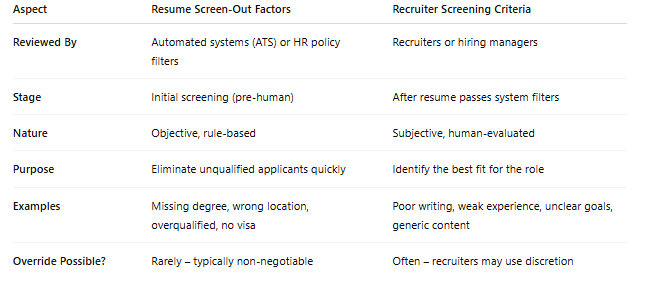
ProTip: Resume screen-out was once limited to automated scans, while recruiter screening was purely manual. Today, both machines and humans may be involved in both stages. Additionally, machines are preferred more by adding specific human requirements.
It’s essential to follow professional resume writing standards and leverage the best strategies to pass both AI and human reviews. But now, recruiters are just for conducting interviews and the onboarding process.
Types of Resume Screen-out Factors
The resume mistakes can cost you a job, including grammar errors, spelling mistakes, and formatting issues. But resume screen-out factors belong to resume strategy. These are more than resume mistakes.
8 common resume red flags
- Business Ownership or Self-Employment
Many recruiters do not consider business ownership or self-employment as professional experience. If you ran your own business, it’s crucial to frame your role with defined responsibilities, achievements, and structure, just like an employee. Moreover, you need to add a professional job title instead of Business Owner.
- Overlapping Dates
Having multiple jobs within the same tenure can confuse recruiters and ATS systems. It raises concerns that you were not, or may not be, fully committed to one employer.
- Age Factor & Outdated Experience
ATS systems flag age as a non-preferred criterion (even if it’s unethical), especially if combined with outdated skills or technologies.
- Short-Term Roles or Job Hopping
Listing several jobs that lasted less than a year can signal job hopping or a lack of commitment. Recruiters may fear you’ll leave their company quickly, too.
- Keyword Stuffing or Missing Targeted Keywords
Adding too many keywords unnaturally may help you pass the ATS, but can have a bad impact during human review. Recruiters can spot forced keyword usage, which makes your resume seem artificial.
- Unexplained Employment Gaps
Gaps with no explanation may appear suspicious. If you took time off for personal reasons (e.g., caregiving, education, relocation, or upskilling), you need to cover this in your career documents.
- Generic Language or Overused Buzzwords
Phrases like “hardworking,” “team player,” “honest,” “go-getter,” or “results-driven” without reflection in your responsibilities and accomplishments come across as clichés. Recruiters prefer specific examples of your achievements and how you added value.
- Irrelevant Job Experience
Including roles that have no connection to the position you’re applying for can screen out your application.
The above resume mistakes can’t be covered with proofreading or attention to detail. To avoid these resume screen-out factors, you need to leverage a proper resume strategy. Don’t know how to manage Business Ownership or Self-Employment, Overlapping Dates, Age Factor, Short-term roles, and Keyword stuffing? ProResumes has published a complete guide on managing these resume issues.
Common Recruiter Screening Criteria
Recruiter screening involves a deeper, human-centered evaluation of your suitability for the role. Hiring managers spend minimal time on your resume in the initial review. They focus on the following things;
- Your Current Resume
- Resume Customization
- Relevant Work Experience
- Key Accomplishments & Impacts
- Key Skills and Competencies
- Resume Presentation
- Cultural Fit
- Career Progression
- Availability and Salary Expectations
- Are your logistics in line with the role’s requirements?
- Motivation and Intent
ProTip: Recruiter selection process is easy to pass if your resume is ATS-friendly and customized to the targeted role, covering all the job posting requirements in the form of keywords. Moreover, if you are reading the job posting information and applying for the best-fit roles, you will surely receive the interview calls. Never apply for the roles if you are lacking 2 to 3 points.
Conclusion
Understanding the difference between resume screen-out factors and recruiter screening criteria and adjusting the job search process is essential for landing interviews in 2025. The screen-out factors and recruiter screening involve AI and human input. From resume optimization to interviews, you need to follow professional guidelines.