
Declining Jobs to Watch for Smarter Education and Career Decisions
Artificial Intelligence (AI) is transforming the way people think and businesses operate, and the world is changing faster than ever. The survival for students, workers, job seekers, and businesses has become tougher in 2025 and is expected to increase by 2030. According to CBS News, declining jobs or layoffs are common in 2025.
The projected job creation and displacement from 2023 to 2027 is alarming and demands that you prepare for the future. According to reports, 83 million jobs are projected to be lost, and 69 million are
projected to be created within different sectors.
292,000+ positions in various industries have already been eliminated due to the Department of Government Efficiency (DOGE). These declining jobs and industries aren’t just statistics. They have become warnings for students choosing degree programs and majors, fresh graduates applying for jobs, and professionals planning for future careers.
Do you know what degree programs are best for a top start in 2025 to prepare yourself for 2030? Do you know how to thrive in 2025? Should you upskill and make a career change? Unsure about the best career strategies and road map until 2030, ProResumes is here to help you future-proof your career.
What Does Declining Jobs & Industries Mean?
The future job market decline means that jobs, services, or industries are at risk of closing due to automation. This doesn’t mean the entire industry will be replaced with AI tools or robots, but the demand for humans will be reduced, and the majority of tasks will be automated.
ProTip: Every career field and sector is shrinking in manpower demand due to automation, artificial intelligence, globalization, climate change, and shifting consumer behavior. Don’t stress yourself with stats of careers becoming obsolete, focus on preparing, adapting, and thriving.
What Are The Most Declining Jobs in 2025?
The major advancements in technology, such as AI, robotics, and automation, are changing the demand for skills, experiences, and abilities at an accelerated pace. New AI technologies and tools can not only effectively manage and improve a growing number of repetitive and manual tasks but also perform and complete knowledge-based work, including strategic research, precise coding, and creative content writing.
ProTip: Reskilling is a strategic imperative. With the right mindset, an effective future-focused career strategy, and self-belief, you can thrive in 2025 and beyond.
Declining Jobs and Industries in 2025
The data and reports from the World Economic Forum and the U.S. Bureau of Labor Statistics highlight that jobs involving repetitive, routine, and manual tasks are likely to vanish in 2025 and beyond.
- Data Entry and Administrative Positions
Positions like data entry specialists or clerks, typists, administrative assistants, executive secretaries, and payroll clerks are in less demand. The process automation and AI tools have made their job by handling a huge volume of manual tasks with accuracy and speed. For example, companies with AI tools and automation can respond to 1000 emails in a minute.
- Clerical and Teller Positions
The job titles such as cashiers, ticket clerks, postal service clerks, and bank tellers are also reducing, but from these categories, some jobs are still in higher demand. The main reason for these jobs shrinking is the awareness of self-checkout systems, e-commerce, automated postal services, and online banking.
- Content Writers and Bloggers
This industry has the most impact of AI tools such as ChatGPT and Google Gemini. These tools have almost replaced content writers and bloggers. A blog of 2000 words with proper SEO or a social media post can be written in minutes with AI prompts.
- Graphic Designers or Other Designing Roles
The graphic designer and related roles are not completely dying, but this industry is undergoing a huge transformation. According to the “Future of Jobs Report 2025,” the traditional graphic design approaches are the fastest-declining job categories.
- Manufacturing and Production Roles
The introduction of robotics and automation is transforming the manufacturing industry. The latest machines perform repetitive assembly and production tasks with greater speed and precision. This is decreasing the demand for human workers for printing and related trades workers, engine and machine assemblers, and various other manufacturing positions.
- Telemarketing and Sales
AI-powered chatbots and automated call systems have replaced telemarketers and some customer service representatives in handling a high volume of basic customer queries and sales calls.
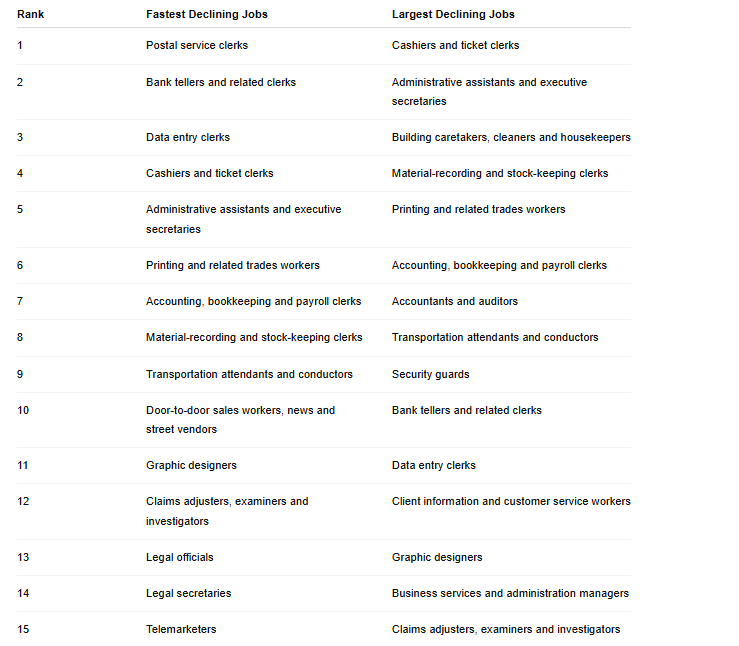
Fastest vs Largest Declining Jobs by 2030
Cashiers, Bank Tellers, Data Entry Clerks, Administrative Assistants, Printing Trades, Accounting and Bookkeeping, Transportation attendants, Graphic Designers, and Claims Adjusters are both the fastest and largest declining jobs. Pursuing education or a career for these roles is the riskiest decision for the future.
Which Job Roles Are Growing By 2030?
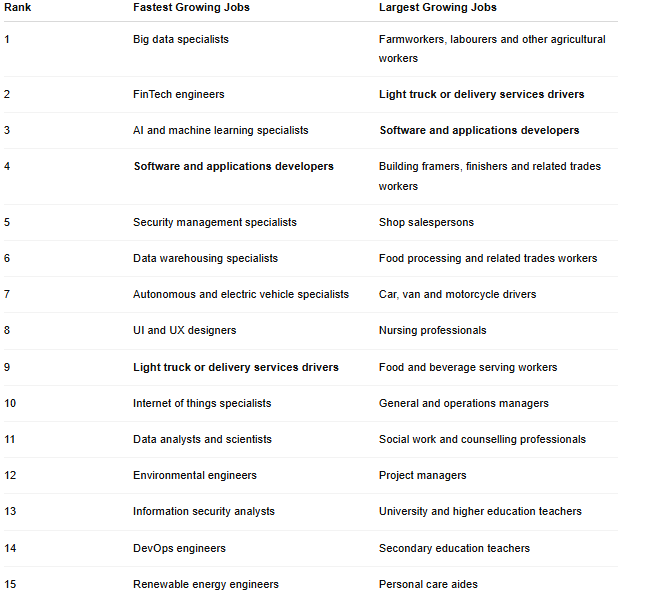
The job roles as software and applications developers, and light truck or delivery services drivers are recognized as both the fastest and largest growing jobs by 2030. Pursuing education and careers related to these fields will be a wise decision.
ProTip: You need a complete career strategy to thrive and land an interview 4x faster in 2025 and 2030. With growing awareness of these fields, competition is rising. That’s why your professional career documents and skillset must be unique and well-crafted to achieve career success.
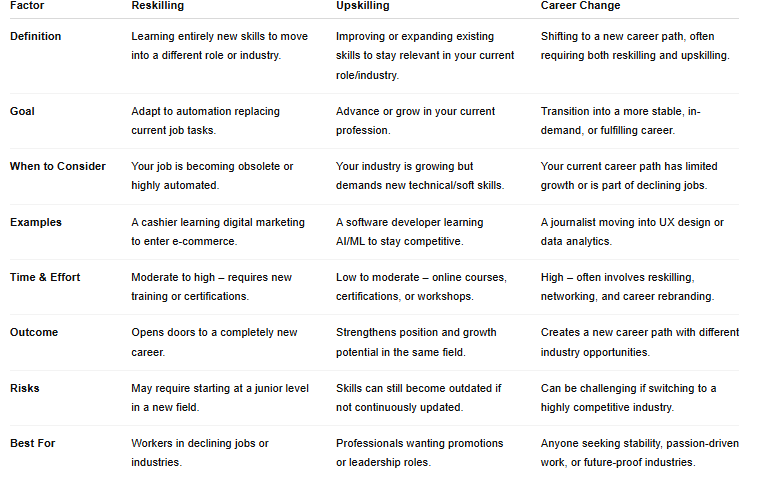
Do You Need to Upskill and Change Career?
Upskilling has become oxygen for your career success. You need to learn new technologies and tools to achieve your career goals. Students, entry-level, mid-career, or executives in any industry need upskilling to compete in the 2025 to 2030 job search market. Additionally, a career change is an option when you don’t see any open doors, but without upskilling, you can’t grow or even change careers.
ProTip: The average half-life of your developed skills is now less than five years, and in some tech fields it’s as low as two and a half years. For millions of workers and industry professionals, upskilling alone won’t be enough. You need a complete career development strategy and reskilling.
Reskilling vs Upskilling vs Career Change
Conclusion
The reskilling for 2030 is key to overcoming the declining job barrier and AI job market impact on your career. According to ProResumes experts, the job search market without upskilling and adapting to AI will bury your dreams into darkness. You need to focus on the future of work analysis, emerging AI tools, and job search market trends for ultimate success. Follow the fastest and largest growing job roles or industries before selecting the education and career path.