
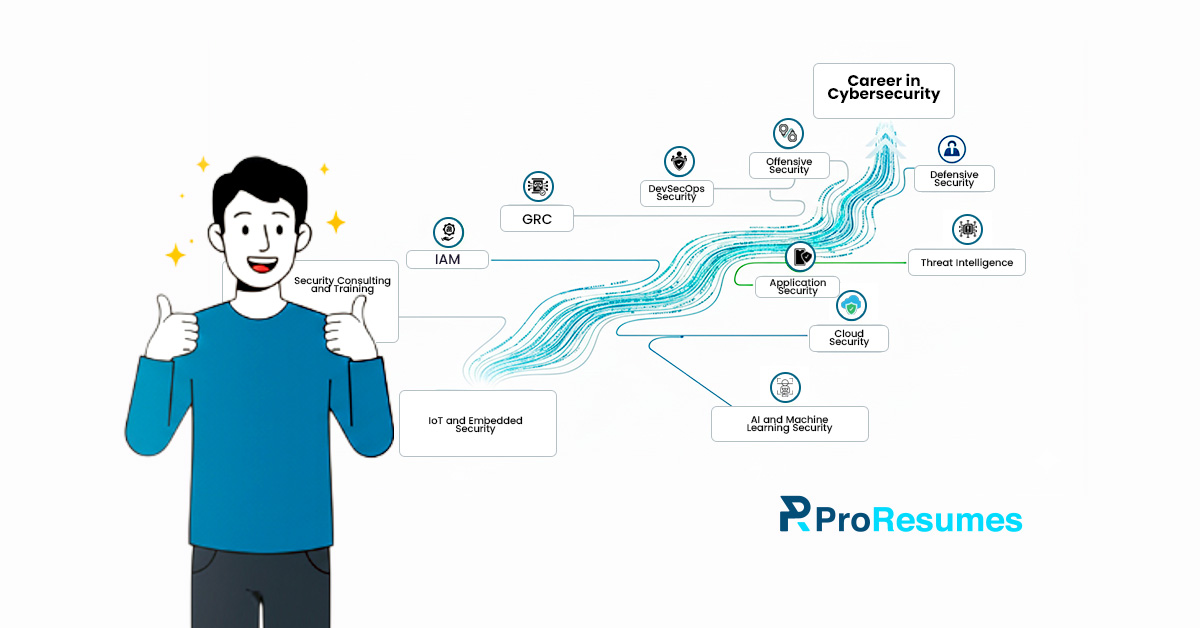
Is a Career in Cybersecurity a good choice for 2026 and beyond?
A career in cybersecurity is the most effective choice due to its rising popularity, according to the World Economic Forum. Jobs for Security professionals are among the fastest-growing jobs by 2030.
Moreover, since it just takes 17 minutes to catch a new vulnerability, the need for cybersecurity professionals is more than ever.
Cybersecurity has emerged as an effective career pathway with competitive salaries, high employment rates, and fast career transition opportunities.
In this guide, we will shed light on the various cybersecurity careers and their specific target areas. Moreover, we will also share steps to build a career in cybersecurity along with the advantages.
What are the career options in the cybersecurity domain?
Here’s a list of diverse options if you’re interested in building a career in cybersecurity:
Offensive Security
Also known as red security, involves the strategies and tactics used by malicious actors to maintain the security posture.
Ethical Hacking: Professionals use hacking techniques to find security vulnerabilities in the network, application, or system.
Penetration Testing: Pen-testers or penetration testers conduct attacks to spot vulnerabilities before they are exploited by bad actors.
Red Team Operations: These operations are conducted to ensure the quality of security measures and to refine them by eliminating vulnerabilities.
Adversary Simulation Testing: These tests are conducted to ensure the effectiveness of the incident response measures of an organization. It utilizes the stimulation of TTPs.
Physical Security Testing: These tests help security officials strengthen security by enhancing access control.
Exploit Development: This technique analyzes the security vulnerabilities and creates exploit code for leveraging them.
Defensive Security
This cybersecurity field encompasses the protection of an organization’s sensitive data and assets from unauthorized access or exploitation. The security team within this field is known as the blue security team.
SOC Operations: These operations include threat hunting, incident response, data analysis, and more.
Incident Response: This is a technique used by incident responders to reduce downtime and control damage after a cyberattack.
Threat Hunting: Incident responders and forensic analysts detect and identify hidden vulnerabilities within systems through threat hunting.
Malware Analysis: Malware Analysts study various forms, functionalities, and the damage caused by malicious attacks.
Detection Engineering: This process is used to design, test and maintain the detection logic that spot intruders or harmful activities.
Endpoint Security: This process protects the security of endpoint connections, including devices that connect to a network. They may include IoT devices or mobile phones, laptops, and more.
Threat Intelligence
It helps security professionals of an organization in using better and effective methods to prevent, detect, and mitigate attacks.
Cyber Threat Intelligence (CTI): Security professionals transform raw threat data into actionable insights to detect and mitigate security risks.
Threat Research: Professionals with a career in cybersecurity gather, analyze and share all the information about emerging malicious activities in cyberspace.
Dark Web Intelligence: Security experts gain insights about cybercriminal activities, stolen information, tools, and strategies after analyzing the dark web.
Indicators of Compromise (IoC): IoCs help organizations collect information about cyberattacks through metadata. The data gathered through IoCs can be in the form of an IP address, type of attack, and more.
Cloud Security
It refers to the use of security practices, tools, and technologies to protect data, infrastructure, and applications in the cloud environment. It is used for threat detection and prevention, network security, and data governance.
Cloud Security Engineering: Cloud security engineers ensure the security of an organization’s digital assets from unauthorized access and exploitation in the cloud environment.
Multi-Cloud Security: It refers to the protection of stakeholder data, stored on multiple cloud servers like Azure, AWS, and Google Cloud. Cloud security engineers protect business reputation and customer trust by ensuring multi-cloud security.
Cloud Governance: It involves the alignment of cloud resource allocation with organizational goals, optimization of cloud storage, and prevention of cyberattacks.
Cloud Compliance: Experts with a cybersecurity career ensure data integrity in the cloud environment according to regulatory standards and security law policies.
DevSecOps Security
Security professionals ensure the development of robust software by testing the product throughout the software development lifecycle (SDLC).
CI/CD Pipelines Security: DevSecOps teams secure these Continuous Integration (CI) and Continuous Deployment (CD) pipelines to ensure operational efficiency, prevent and detect threats.
Kubernetes Security: Security engineers analyze and protect Kubernetes clusters, containers, and data from cyber threats and malicious actors.
Container Security: It involves the use of tools, security policies, and best practices to ensure the security of complex containerized environments.
IaC Security: Security professionals with a career in cybersecurity analyze the security configuration issues related to the infrastructure as code (IaC) layer. IaC saves organizational resources with automation and scalability, but is prone to security threats.
Application Security
It is used during the whole SDLC phase and secures the data and code of any software application from emerging malicious threats.
Secure Coding: It includes the programming practices to develop reliable, robust and secure products by ensuring system and data security.
SAST, DAST, and IAST: These are the emerging security technologies that are used to address security issues during the development of software.
SDLC Security: It includes the tools, technologies, security frameworks, and practices to ensure the security of software during the development phase.
API Security: The process of Application Programming Interfaces (API) security is used to detect and mitigate security vulnerabilities within software applications.
Product Security: Professionals with a career in cybersecurity make sure that the security of software is intact from development to maintenance.
Governance, Risk and Compliance (GRC)
The strategy used by organizations to manage data governance and security risk, along with staying compliant with industry regulations.
Risk Assessment: It is used to detect, evaluate, and prevent security vulnerabilities from damaging the information security system of an organization.
Audit and Compliance: The process of finding and removing vulnerabilities that can be exploited through unauthorized access and result in a security breach.
Policy Development: It is the process of aligning organizational requirements and security regulations to secure the information security system.
Vendor Risk Management: Experts with a career in cybersecurity use this process to identify and resolve the security concerns linked to third-party systems.
NIST, ISO, PCI, HIPAA, and GDPR: These are the security compliance standards and frameworks that cover compliance measures, risk management, and data protection policies.
Digital Forensics and Incident Investigation
DFIR combines a team of forensic analysts and incident responders to identify, analyze, and mitigate looming cyber threats.
Computer Forensics: Cyber forensic teams use this strategy to detect and counter existing cyber threats and prevent future attacks by retrieving data.
Mobile Forensics: It is used to gather and retrieve cyber threat data from mobile devices for legal procedures.
Malware Reverse Engineering: Malware Analysts learn about the specifications of malware to find new security solutions for threat prevention and mitigation.
Cybercrime Investigations: The professionals with a career in cybersecurity help law enforcement officials identify and prosecute individuals involved in cybercrime.
Identity and Access Management (IAM)
It involves the procedures and policies to ensure the protection of digital identities and authorized access to sensitive organizational data.
IAM Engineering: The IAM engineers are involved in the implementation and optimization of identity and access management policies to maintain the security posture.
Zero Trust: It is a security framework that follows strict procedures to verify the identities of devices and users before giving them network access.
Privileged Access Management (PAM): It is a discipline that protects the identities of users with privileged access to data or networks, such as admins.
Identity Governance and Administration: It allows security teams to stay compliant while managing digital identities and user access to organizational systems.
ICS/OT and Critical Infrastructure Security
Industrial Control Systems (ICS) and Operational Technology (OT) play a vital role in the protection of critical infrastructure. Individuals with a career in cybersecurity build these systems for seamless operational efficiency and prevention from cyber threats.
SCADA Security: Supervisory Control and Data Acquisition (SCADA) systems security ensures threat protection for data and management control of industrial systems.
Industrial IoT Security: IIoT security is used to secure interconnected systems and networks within industries that manage and automate the physical processes.
Smart Grid Security: Experts with a career in cybersecurity help in securing the vulnerable grids from cyberattacks that can cause data exploitation. Security professionals ensure the delivery of electricity by strengthening the security infrastructure of smart grids.
Automotive Cybersecurity: Security engineers ensure the security of communication between interconnected parts of automotive vehicles from malicious activities.
Rail and Aviation Cybersecurity: Professionals with a career in cybersecurity ensure the seamless function and protection of critical infrastructure through regulatory measures.
IoT and Embedded Security
This security discipline focuses on the protection of embedded connections and interconnected devices and networks within the Internet of Things.
IoT Device Security: The security of an IoT device involves protection from unauthorized access due to weak passwords, network segmentation, and more.
Firmware Analysis: Security professionals analyze firmware to spot and fix security weaknesses. Firmware analysis is conducted by analyzing TSL/SSL certificates, CVE analysis, password hashing, and more.
Embedded Device Pen Testing: Penetration testers launch attacks to find and remove hidden vulnerabilities embedded in the information security system of an organization.
Hardware and Semiconductor Security
This security discipline is involved in the protection of physical devices from security weak spots and data exploitation or theft.
Chip Design Security: It involves the production of integrated circuits (ICs) from the design to manufacturing phase to ensure system integrity and secure communication.
Side-channel Attack Research: Security professionals who analyze side-channel attacks find how electrical components are exploited to build strict defense mechanisms.
Hardware Trojan Detection and Prevention: This security procedure is used to detect and remove the malicious content within integrated circuits to avoid security disasters.
AI and Machine Learning Security
Artificial Intelligence and Machine learning are used to automate security processes with fast and smooth threat detection and prevention.
Adversarial ML: Security engineers analyze the vulnerability of a machine learning model that is tempered to produce inaccurate data and outputs.
LLM Security: IT experts with a career in cybersecurity study corrupted language learning models to detect malicious content and build defensive strategies.
AI Governance and Risk management: It involves the security regulations an organization abides to ensure the ethical use of AI and the avoidance of risks.
Model-based Security Testing: These security tests are conducted to ensure that software aligns with security pillars like authenticity, integrity, and more.
Blockchain and Web3 Security
IT professionals with a career in cybersecurity ensure blockchain and Web3 security to protect the digital assets from being exploited by cyber criminals.
Smart Contract Security: This security principle includes policies to develop and interact with smart contracts that ensure their security in blockchain networks.
Web3 Pen Testing: Pen testers conduct cyber-attacks to find security issues within the blockchain networks to come up with new security measures.
Crypto or Wallet Security: This includes the security of cryptocurrency from malicious actors by strong authentication and access control.
DeFi Security Auditing: These audits are used in finding vulnerabilities and securing smart contracts from unauthorized access, data theft, and more.
5G Security and Telecommunication
Professionals who build a career in cybersecurity use strong measures to protect the network infrastructure and customer-sensitive data.
5G Core Security: Security professionals ensure the core security of 5G networks to maintain the data integrity and confidentiality of user communications.
Telecom Protocol Security: This is a security measure that is used to ensure that security protocols are safeguarding data transmitted through network connections.
Signal Intelligence Security: Security Analysts gather and analyze data collected from these communication networks to find any looming national security threats.
Data Privacy and Protection
This branch of cybersecurity deals with the access controls for sensitive data, along with security protocols that decide to permit or restrict user access.
Data Protection Officer: The DPO has a career in cybersecurity and deals with the protection of organizational data and assets, according to the security compliance laws.
GDPR/CCPA Compliance: These are security compliance laws created and implemented to ensure users’ personal data protection from unauthorized access.
Privacy Engineering: This security discipline implements privacy controls from the start of IT product development through access control and encryption policies.
Security Program Leadership & Strategy
This strategic security planning involves the production of policies and frameworks that protect data, users, and assets from cyber-attacks.
Cybersecurity Manager: These professionals have a career in cybersecurity and are responsible for leading a team of security engineers. They make sure that the organizational data and reputation are secure from cyber criminals.
CISO: The chief information security officer ensures the alignment of business objectives with security policies and regulatory compliance.
Program Director: Program directors with a career in cybersecurity lead security teams and ensure smooth operations within an organization’s security infrastructure.
Security Operations Leadership: They lead the security teams and protect organizational assets through incident response, risk management, and security strategies.
Security Consulting and Training
This involves the use of security consultations to analyze existing security posture to find vulnerabilities and enhance the protection measures.
Cybersecurity Consultant: These consultants have a career in cybersecurity and play a crucial part in strengthening the security systems of organizations.
Security Awareness Trainer: These professionals are responsible for educating employees within an organization on various cyberattacks and security tactics.
Researchers and Analysts: These security professionals are responsible for analyzing different malware, cyber threats, attack tools, and hacking techniques for designing security alternatives.
How to start a career in cybersecurity?
We’ve discussed various cybersecurity career paths and specialties. Let’s explore the way to start a career in cybersecurity:
Educational Requirements
To start a career in cybersecurity, it is important to gain a bachelor’s level degree in computer science or information security. Cybersecurity is a specialized field and demands a strong foundation, so having a four-year degree is ideal.
Interested individuals can also get a master’s degree in a specialized field of cybersecurity.
Trending Cybersecurity skills
Here’s a list of cybersecurity skills that you can develop and add in your resume for better job opportunities:
- Network and Application Security
- Threat Intelligence
- Risk Management
- Vulnerability Assessment
- Incident Response
- Cryptography
- Forensic Analysis
- Identity and Access Management (IAM)
- Data Security
- Cloud Security
Certifications in Cybersecurity
Here’s a list of some cybersecurity certifications to refine your expertise:
- CompTIA Security+ (for specialists, professionals, and experts)
- Certified Ethical Hacker (CEH)
- Certified Information Security Auditor (CISA)
- Certified Information Security Manager (CISM)
- GIAC Security Essentials Certification (GSEC)
Gain practical expertise
It is difficult to gain a specialized cybersecurity job without enough experience. The easiest way is to gain some expertise working in entry-level positions like IT Support, System administration and more.
In this way, you can build practical experience by working with networking and systems.
Cybersecurity professional resume
Once you’re done with the essentials, craft a cybersecurity professional resume and submit it whenever you find good job opportunities.
Do you know that many deserving candidates lose job opportunities because of Applicant Tracking system(ATS) scans? If you’re serious about starting a career in cybersecurity, get in touch with ProResumes. We build professional resumes with ATS optimization and a 99.99% interview guarantee.
How to figure out if a career in cybersecurity is worth it?
You are eager to build a career in cybersecurity but aren’t sure whether it will be a good match. Here’s a checklist to find where your interest lies:
Understanding of Systems
- Do you have a basic understanding of topics like operating systems and networking?
- Do you invest time in learning about the complex digital security processes?
Purpose-oriented Career
- Do you want to build a career in cybersecurity just for the sake of opportunities?
- Do you want to serve the community through your career?
- Are you interested in a purpose-driven career?
Sharp Problem-solving skills
- Do you have sharp problem-solving skills?
- Do you enjoy solving things from a logical perspective?
- Do you like solving complex issues or giving up in the middle?
Persistent nature
- Do you focus on challenging situations to resolve them?
- Do you focus on minor details within complex tasks?
- Can you maintain your focus or have a weak attention span?
Benefits of starting a career in cybersecurity
Since cybersecurity is a relatively new field than other technical fields, it offers various advantages, such as:
High Employment Rate
As the attacks are intensified, so is the need for a cybersecurity professional. According to LinkedIn job search results, there are almost 90,000 cybersecurity jobs available for US job seekers.
Moreover, there are currently 18,992 cybersecurity jobs available in the United States, as per Glassdoor.
Competitive Salaries
Cybersecurity professionals earn more on average than any other expert in other technical fields. According to PayScale, a cybersecurity engineer’s salary in the US is around $106,300 on an annual basis. Senior or experienced cybersecurity professionals earn $151,00 while entry-level employees make $81,000 per year.
Seamless Career Advancement
A career in cybersecurity is effective if you’re looking to transition to better roles, such as a CISO role. Compared to other domains, career advancement in cybersecurity offers a seamless transition.
Future-proof professional domain
Organizations offer various cybersecurity positions every year to maintain a security posture and data integrity. Since new and advanced cyber threats are launched every minute, the cybersecurity career is future-proof.
Enjoy the perks of a career in cybersecurity
According to the employment landscape in the future, having a career in cybersecurity is a smart choice for stability.
However, it also depends on your work-life preferences, career aspirations, and ambitions.
It is important to assess your particular interest in a professional domain before choosing a career path.
Frequently Asked Questions
Q. Is cybersecurity full of mathematical knowledge?
Not every role or job in a cybersecurity career is math-heavy or requires rigorous mathematical skills. However, some specialized fields like cryptography or encryption require good mathematical skills.
Q. Can you get a cybersecurity job with no experience?
No, cybersecurity is a complex field and demands deep knowledge and expertise. It is important to gain experience in the form of entry-level positions and internship projects.
Q. What are the disadvantages of cybersecurity?
Building a career in cybersecurity is not for every individual. Here are some reasons why a cybersecurity career won’t be worth it:
- It is a challenging domain.
- There is a lack of resources.
- Companies don’t invest in a good budget.
- Lack of Data security due to advanced cyber-attacks.
- No proper work-life balance.
- 24/7 Availability.