
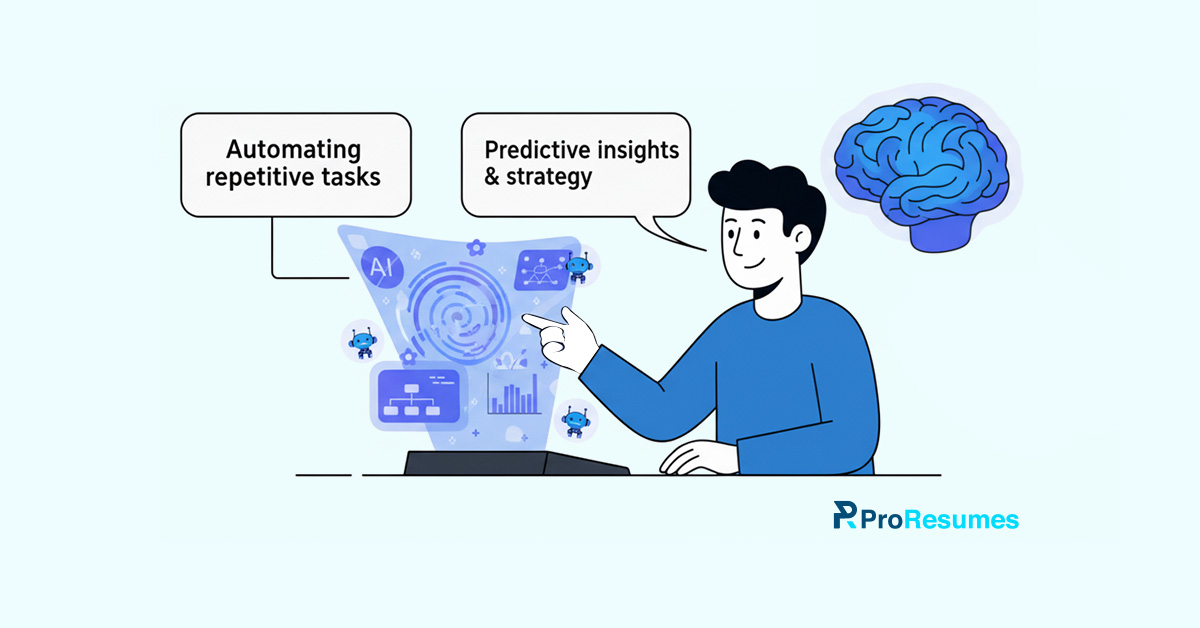
Transforming the future of Business Analyst with AI
AI technology isn’t replacing the jobs of Business analysts, instead it is giving them the opportunity to deal with businesses.
More than 70% of organizations have been using AI to improve their business processes, according to the 2024 McKinsey statistics.
Where AI technology enhanced the productivity level of organizations worldwide, it also replaced many entry-level jobs. General Business Analysts or employees at junior or entry-level positions have also faced lay-offs and massive competition in career opportunities.
However, the mere tasks replaced by AI are data extraction, documentation, and research. It didn’t replace the much-humanized aspect of the Business Analysis niche. It can never replace the subjective level of human thinking, which involves critical analysis and problem-solving skills.
We need to view the Artificial Intelligence advancement in Business Analysis from a rather different perspective.
Fast-paced data analysis
The data analysis is the core part of the business analyst’s decision-making process to improve business efficiency. AI tools can analyze large quantities of data in mere seconds which was humanly impossible for Business Analysts.
This AI and business analysis collaboration has made it easy for BAs to concentrate more on producing effective business strategies. They can leverage several AI tools to spot market trends, customer perspectives, and more to create data-driven strategies.
Saying no to mundane Business Analyst routine
Before the advancement in technology and rise of AI tools, the role of BAs was mostly limited to mundane routine. Now they can use automation tools to generate reports and collect data.
They have more time to interact with stakeholders and arrange collaborative discussions to make informed choices. Rather than spending all their time with data and tools like Power Bi, Jira, and Tableau, they extract pain points.
Enhancing User experience
AI and business analysis tools can be used to develop products that can enhance the user experience. These tools spot customer needs, marketing, demographic, and psychographic facts in no time.
This helps business analysts in analyzing and detecting patterns that encourage the production of customer-friendly business solutions. Moreover, this also minimizes risks and ambiguity when it comes to the development of projects.
Skills essential in the AI-friendly era of Business Analysis
We’ve discussed the relationship between AI and Business analysis from a positive perspective. However, pursuing a career as a business analyst in this AI-driven world requires strategic and analytical thinking.
AI didn’t eliminate career opportunities for BAs; it instead changed the landscape of their profession. It is important to learn both AI and business analysis skills to surpass the generalist and non-technical BAs.
We’re just two months away from the year 2026 and this is your chance to future-proof your BA position.
Learn these ultimate skills to train your business analyst mind:
Understanding of Business goals
The deep understanding of achievable business goals is the most crucial aspect of being a business analyst. LLM tools cannot think like a human to understand the challenges of a business. Business Analysts often face challenges when it comes to business goals and project requirements. It is the job of the business analyst to elicit refined requirements from stakeholders. Moreover, AI technology also needs clear specifications to provide effective business solutions.
Refining Interpersonal Communication
Even though the AI technology has been advancing at a speedy pace, it can’t replace the BAs’ interpersonal communication skills. However, there is a rise in the use of AI and business analysis models that can meet the requirements of stakeholders. The BAs are required to refine their communications skills and learn tactics that can eliminate miscommunication with stakeholders. They can use AI chatbots for initial requirement gathering and then refine them through stakeholder meetings.
Critical Analysis Capability
AI tools can help business analysts when it comes to spotting trends in data. However, it depends on the critical analysis of a BA to explore and refine it further by analyzing feedback and end user perspective. Eliciting requirements by solid questioning and analysis is important to mediate between the stakeholder and project development team.
Use of SQL
The majority of business analysts in the past used to avoid learning SQL. However, with the emergence of AI, learning SQL queries is more crucial than ever. Understanding and using SQL to write queries and data interpretation is an important technical aspect of business analysis. Having the ability to use SQL can help BAs in interpreting and verifying data gathered through AI tools as well.
Proficiency in Programming Languages
Understanding various programming languages can help business analysts with storing and refining data. Being proficient in these technical aspects will widen the scope for BAs in this era of AI. This will also help Business analysts while communicating with the Information technology team.
Prompt engineering
Business analysts can speed up their work processes with the integration of AI tools into their systems. They can master the skill of effective prompt generation to refine stakeholders’ needs into unambiguous and clear prompts. This will help them with data extraction, documentation, report generation, and more.
Understanding of wireframing
Business Analysts should be experts when it comes to translating stakeholder requirements in the form of prototypes. They can make use of tools like Figma to create project wireframes and save time and effort for the whole team. Wireframing helps end users visualize the project outcomes and avoid unnecessary requirement changes in future.
Building AI and Business Analysis symbiotic relationships
It is important to foster AI and business analysis relationships that can work synergically, rather than treat AI as an enemy.
Business Analysts can leverage the LLM models by using them to speed up their work progress. However, they should only use these artificial intelligence tools according to ethical standards.
They can invest the time saved from automating their boring routines in improving business processes through data-driven insights.
Having expertise in AI and business analysis tools will help them in refining their critical communication with all the parties.