
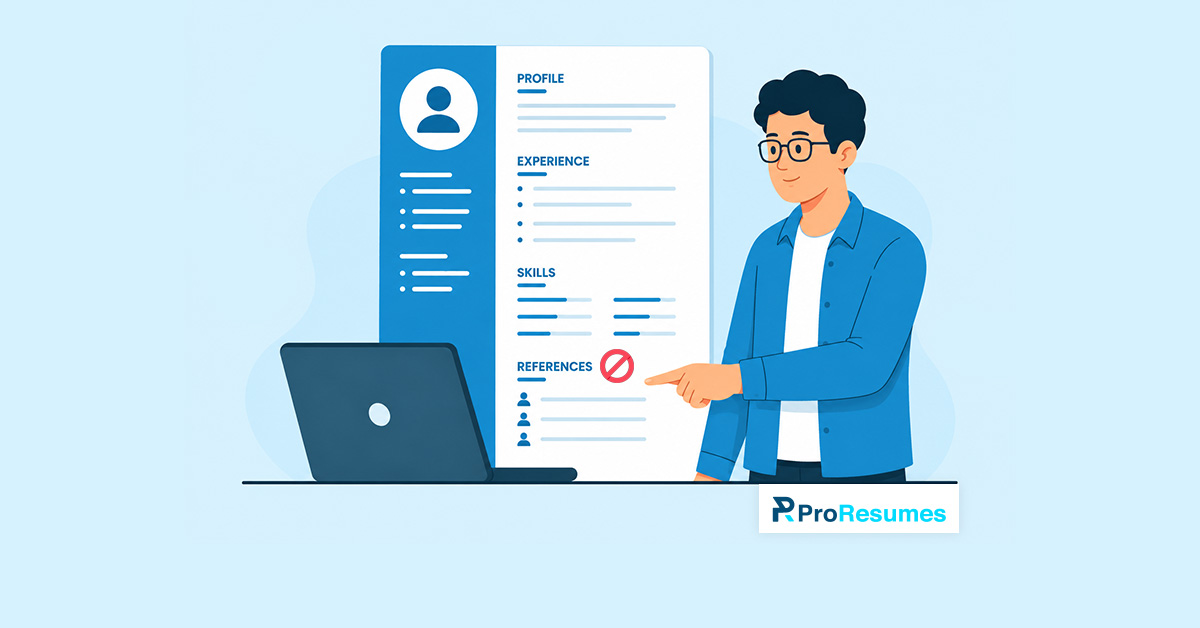
Can you add references in a resume in 2026?
Ideally No! You shouldn’t add any references in a resume in 2026, since it is considered an outdated resume-writing practice.
According to Kelli Hrivnak, a recruiter in the tech and marketing niche, “Save the space on your resume.” Kelli stated that resumes in 2026 should be modernized and avoid mentioning references.
Do you want to know what is the best way to show your references to a hiring manager?
In this guide, we will discuss why you shouldn’t have references in a resume. Explore what a reference list is and how to prepare one. Moreover, learn how and who to ask for references.
Want to learn some ideal ways to create professional resumes? Explore the expert resume writing advice by certified career development professional.
Why do you need to avoid adding references in a resume?
Career experts at ProResumes don’t recommend the use of references in a resume due to the following reasons:
Limited Space
According to TalentTuner, the initial resume screening time is approximately 7 seconds. You need to provide significant and valuable details in less space to grab the attention of the recruiter. Adding insignificant things will only reduce space for the experience or educational details, decreasing the candidate’s value.
Ageism Bias
Modern resumes are devoid of references since they are submitted separately. Adding references in a resume will not only make your application seem outdated but will also make you appear old. Many recruiters look for young candidates and details like these put your job application at a disadvantage.
Lack of Time
Recruiters have to go through hundreds or even thousands of applications during the initial process of resume screening. They don’t have the time to call the references of each candidate to confirm their experience, skills, or personality.
According to Kenneth Lang, a job search mentor on LinkedIn, people need to skip the use of references in resumes. He advised, “Let people recommend you on LinkedIn as a replacement for those references.”
Kenneth recommends using LinkedIn recommendations to show credibility by adding a LinkedIn account to your resume.
What is the purpose of such professional references?
Recruiters ask for references to ensure a candidate’s worth, experience, skill set, personality, certifications and more. Hiring managers filter some candidates based on their interviews, tests, or work samples.
They ask the candidates to provide a reference list to confirm the value, impact, and achievements of an applicant. Hiring managers usually contact references to ensure the right hiring decision.
Why do people use the phrase “references available upon request”?
Many job applicants avoid giving direct references in a resume because of limited space and the privacy of the references’ information.
Moreover, the phrase also helps in telling the employer that there are people who can endorse your expertise and skills.
However, many recruiters and career coaches don’t recommend the use of “references available upon request” in your resume.
Colleen Paulson stated that “It’s old-fashioned and takes up valuable space.”
Moreover, she stated that it’s clear that you have to share the references later in the hiring process. So, there’s no need to mention it explicitly in the resume.
What is the resume reference list?
A resume reference list is a separate document that is submitted to a recruiter during the hiring stage, mostly after interviews. The document is a list of the background and contact information of the references, provided by the applicant.
Recruiters ask for this list to confirm your personality, achievements, expertise, and work ethic. Many experts advise job seekers to prepare their resume references list before submitting a job application.
Here are the following things that you should do before preparing your resume references list:
Find the people you need as your references
Before you create a reference list, you need to figure out the people who can be your references. Deciding on references also depends on your level of professional authority.
For example, if you’re a fresh graduate with little to no experience, you might need one or two academic references. A well-experienced employee with a decade or more of work experience can provide multiple references.
Pro Tip: It is recommended to add more than one reference in your references list to provide options for a recruiter.
Do not add too many references
It may seem delightful to add a bunch of references to the list; one should be considerate of the recruiter’s time. Filter for solid references from the chosen ones who can endorse your value and skills in the best way.
The ideal candidates to serve as your references can be mentors, past employers and colleagues, and advisors. According to Genevieve Northup, you should select the people who’ve worked with you and can specifically describe your value.
Choose the relevant people to endorse you
You need to tailor your reference list just like you tailor your resume according to a job description. Select the people who can highlight your skills and work experience relevant to the job you’re applying for.
Decide how to submit the reference list
You should submit your reference list with the resume submission only if the recruiter has requested it. Otherwise, the list should only be submitted when a recruiter asks for it during any hiring stage.
Who is acceptable to be used as a reference?
Before deciding which individuals, who can act as your references, ensure that they can endorse you properly. Your reference list is created according to the level of experience and authority you have. It includes the following professionals, such as:
References for candidates with work experience
Job applicants can generally use the following references:
- Former managers and supervisors
- Freelance Clients
- Past Colleagues
The following business references can be used in the reference list:
- Mentors
- Acquaintances from past workplaces.
- Acquaintances from training workshops or courses.
References for freshers with no work experience
The entry-level job applicants can use the following references:
- Professors
- Academic advisors
- Volunteer Heads
Freshers with no experience can use the following references:
- Instructors
- Coaches from university clubs
- Project mates
- Club members or leaders
How do you ask someone to act as a reference?
It is necessary to ask your contacts and acquaintances before adding them as your references. The following are some ways that can be used to ask someone to act as your reference:
Get their permission
The first thing is to get in touch with the individual and ask them to be your reference. This will help them prepare themselves if they get contacted by the recruiter. Moreover, it is essential to thank them for their consideration and follow up.
Ensure their willingness
It is your duty to ensure the willingness of the individual to be your reference. They should have the option of declining your request.
Give them the information
You should inform your reference regarding all the necessary details about the job including job description, organization’s name, and more. Career experts recommend sending your resume to the references so they can highlight the relevant experiences and skills.
How to prepare the references list?
The following is the list of details that you should mention regarding a reference in your list:
Add their names and titles
To help the recruiter ensure the authenticity of a reference, add their professional titles.
Add work address and organization
Adding organizational names and addresses will help the recruiter conduct a quick check on the reference for credibility.
Add email address and number
It is important to provide the references’ work email address and contact number. Don’t give away the personal contact information of your reference.
Add brief descriptions
Add a line or two, highlighting your connection with the reference and why they’re the best ones to endorse you.
What are the circumstances where you can add references in a resume?
Even though adding references in a resume is no longer the norm, it can be added to a CV application. You can add it in the following circumstances:
Required in Job Application
Most of the time, recruiters ask for references within your job application. If a recruiter has explicitly asked for references, make sure to add them.
Rewarded by the Reference
If you’ve had past experience of receiving a reward from a reference, you can include it for credibility.
Fill up Empty Space on Resume or CV
If you’re a freshman with no experience and have some white space left on your resume or CV, add references.
Make Job Application credible
Adding references in your job application shows that you’ve nothing to hide and have people back your claims.
Contact ProResumes to get your resume perfectly crafted by certified writers according to modern guidelines.
Key Takeaways
- It is not necessary to add your references in a resume without the explicit requirement of the recruiter.
- Use a resume reference list to add all your references who can vouch for your hard or soft skills and experience.
- Always ask for permission before adding the details of someone in your reference list.
- Use LinkedIn recommendations as your reference list.
Frequently Asked Questions
Q. Who cannot be used as a reference in a resume?
Personal connections that are closely linked to a candidate can’t be included as references in a resume. Personal connections can include people like your parents, siblings, or friends. Recruiters clearly disregard references from personal connections since these individuals can be biased due to their personal link with you.
Q. What are character references in a resume?
Character references in a resume refer to the endorsement by someone regarding a job applicant’s character and reputation. Many employers ask for such references in a resume to confirm a candidate’s soft skills.
The people who can be included as character references include the following:
- Mentors
- Coworkers
- Neighbors
- Professors