
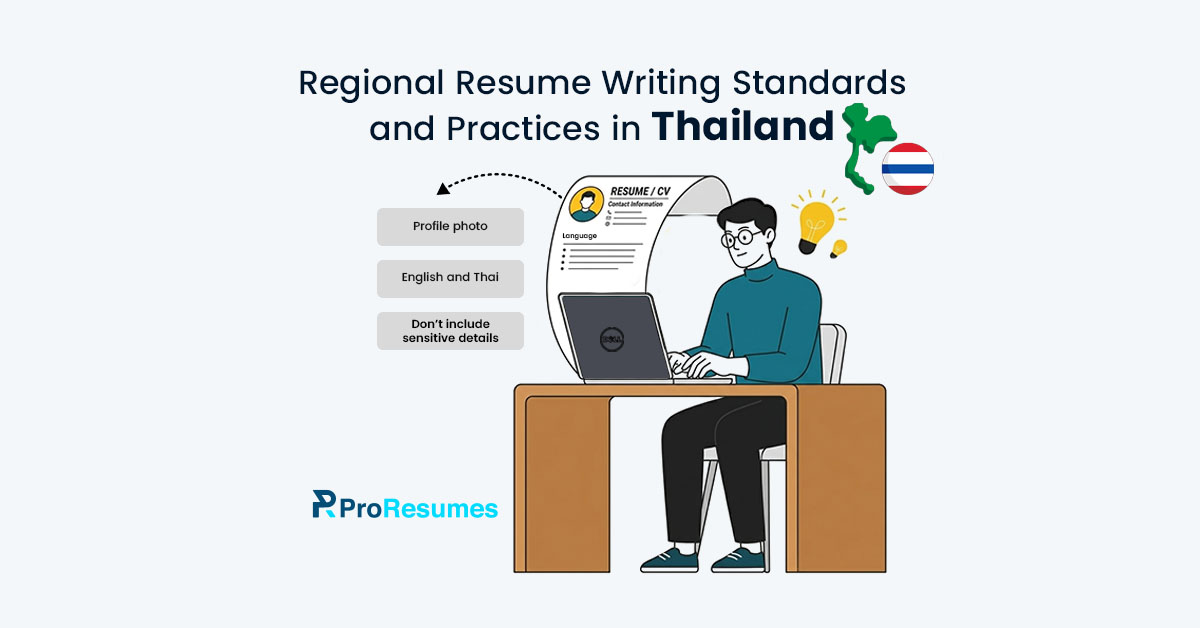
Regional Resume Writing Standards and Practices in Thailand
Are you looking for opportunities to gain a job in the Thai education or tourism sectors?
In this guide, explore how to craft a resume in Thailand by following the Asian resume standards and country-specific trends.
Related: Regional Resume Writing Standards for Applicants in Singapore
What is the document name used for the job application in Thailand?
Thai people use several different words while referring to a job application document. Since English is mostly used in the country, the population utilize the word “resume” which is often pronounced as ray-soo-may.
Moreover, they also use the Latin word Curriculum Vitae or its abbreviation, CV. However, since the word CV is sometimes utilized for academic or detailed documents, the word resume is preferred.
Additionally, the Thai population also use the word Bæb fxr̒m s̄mạkhr ngān (แบบฟอร์มสมัครงาน) which means a job application form. These forms are computerized and can be filled and submitted digitally.
Regional resume standards followed by the Thai job applicants
Since Thailand is situated in the Southeast Asian region, it follows the resume standards followed by Asians. However, Thai resumes are also quite similar to the Western resumes and follow these standards:
Resume Length
The length of the Thai CV or resume documents is around one to three pages in general. However, the Thai employees prefer conciseness in resumes, so applicants should use a one-page or max two-page resume.
Thai career coaches recommend the use of a one-page resume in following situations:
- When the applicant is a fresh graduate.
- When the applicant wants to change their career.
- When the applicant has less than 7 or 10 years of working experience.
Meanwhile, two-page or even three-page resumes are often used by the following job applicants:
- When the job applicant has more than 10 to 15 years of relevant experience.
- When the applicant is applying for a senior job positions or leadership roles
- When the applicant is applying for a job in the technical industry, like information technology.
Paper Size
The standard paper size used for the Thai resumes is the German standard ISO 216. The German standard includes the A paper series which include A4 paper size that was adapted by Thailand in 1973.
Moreover, as per the A4 standard, the dimensions of a Thai resume document are almost:
- 21 x 29.7 cm
- 8.27 x 11.69 inches
- 210 x 297 mm
Resume Format
The Thai recruiters prefer resumes in a reverse-chronological format especially in hierarchical markets or industries. The reverse-chronological format is valued by both applicants and hiring managers because:
- It shows a clear career progression of the job seeker.
- It clearly highlights a job applicant’s depth of experience.
Apart from this, the applicants can also use the following resume formats:
Functional format: This resume format emphasizes skills over work experience. Moreover, this format is usually used by applicants who want to change their careers or freshers with no experience.
Hybrid format: The hybrid or combination resume format can be used to highlight both skills and work expertise. It can be used by applicants to cover their employment gaps by highlighting skills development.
What kind of languages are used in Thailand for adding details to a resume?
The resumes in Thailand utilize the following languages for sharing the job seeker’s details:
Thai
The Thai language is the main language of the country which is used by the majority of the population. Moreover, it is often expected as resume language by hiring managers in the local sector or small businesses. Moreover, the resumes are written in the Thai language when the application is for a role that requires local interaction.
English
The main resume language that is used in Thailand is British English. The UK English is used for almost all job applications in the country regardless of the organization’s foreign affiliation. Even though US English is also used in the country, the UK version is highly preferred for professional settings.
The UK version of English is mostly used while applying for jobs in the following:
- International school
- Multinational corporations
- Foreign-affiliated organizations
- Tourism industry
However, the job applicants should be careful about the UK spellings, grammar considerations and more to add details in a resume.
Unsure of the correctness of UK spellings and terminology in your resume? Reach out to certified resume writers at ProResumes with a message and get a perfect job application within days. Moreover, impress Thai recruiters with resumes tailored for the job post.
Does a resume in Thailand require an applicant’s photo?
Yes, the resumes in Thailand often include an applicant’s photo. Local recruiters or small businesses require a resume picture, while international organizations don’t require one.
Since international companies follow the resume standards used in North America or Europe, they exclude applicant photos from resume requirements. However, the best way to confirm the photo inclusion is to confirm the recruiter’s requirements or avoid including it.
Moreover, the job applicants who are expected to add their photo should abide by the following rules:
- Always get a professional shot for the resume picture.
- The applicant’s face should cover 60% of the resume picture.
- Avoid using any kind of beauty filters, makeup, unnatural lighting, or image-editing application.
- Use neutral, blue, or white-colored backgrounds for the resume picture.
- Maintain positive yet professional facial expressions with a subtle smile.
Are references included in a resume or CV in Thailand?
Yes, the practice of adding references directly in a resume is still considered a norm by Thai organizations. Unlike the Western recruiters that don’t require references in the initial stage, the Thai hiring managers often expect them.
Many Thai applicants include the phrase (references available upon request) in their resumes. However, it is preferred to include at least two professional references for work positions that demand trust.
However, applicants can prepare a separate references list to include their references and submit them with the resume. The list can include the following details, such as:
- Reference’s name
- Reference’s Profession or Job Title
- Reference’s Phone number
- Reference’s Email ID
- Reference’s organization
- Reference’s credibility
Pro Tip: Always get the consent of a referee before adding their details to your references list or resume.
Moreover, job applicants can also provide letters or recommendations instead of references since they’re valued by Thai employers.
What are the resume sections used in a job application document in Thailand?
The job application documents in Thailand include the following sections, such as:
Personal information
The top section of the Thai resumes often include the following details:
- Full name (Both in English and Thai)
- Email address with professional domain
- Active phone number
- Location (For on-site jobs and commute purposes)
- Professional photo (Optional for international companies)
- Nationality or Work permit status (Only mentioned in Thailand resumes for foreigners)
The Thai resumes don’t include sensitive details of the applicants including:
- Marital status
- Age
- Date of Birth
- Residential address
- Religion
- National ID number
- Gender
- Parents name
- Parents occupation
- Previous salary
Resume summary
The resume summary also known as professional summary is:
- A concise paragraph with 5 lines at max.
- It gives a quick summary of your career.
- It should be attention-grabbing.
- It highlights top skills and achievements.
- It emphasizes the length of expertise.
Work Experience
The work experience section of Thai resumes is formatted in a reverse-chronological order and focus on relevancy. It includes the following elements, such as:
- Name of the organizations
- Dates of employment
- Main work position of the applicant
- Main word duties of the applicant
- Use of quantifiable data
- Use of the STAR framework
- Add internship experience
- Add local or Southeast Asian expertise
Pro Tip: Avoid including any kind of irrelevant information in the Thai resumes. If you’re a fresher or career changer, tailor your experience or skills according to the job as much as possible.
Education
The education section in a Thai resume is structured reverse-chronologically and include the following:
- Name of the degree or diploma
- Institute name
- Years attended
- Include relevant coursework
- Include professional certifications
Skills
This section of the Thai resume is divided into the following categories to list relevant competencies:
- Hard Skills
- Soft Skills
Additional Sections
The other sections that are often a part of the Thai resumes include the following:
- Hobbies and Interests
- References
- Language Proficiency
- Certifications
- Voluntary Work
How to enhance the impact of a resume or CV in Thailand?
Following are some of the tips that can be utilized to optimize a Thai resume:
- Ensure the use of industry-specific keywords and terminology for ATS optimization.
- Never include any irrelevant experience in a Thai resume.
- Avoid the use of extra creative or graphical elements.
- Avoid using infographics, tables or any columns in a Thai resume.
- Avoid adding any sensitive information such as marital status, parent’s name, or more.
- Use the white space in a resume to ensure readability.
- Always use consistent fonts and sizes in a Thai resume.
- Always proofread your resume before submitting it.
Interested in learning more about ATS optimization? Check resume guidance blogs on ProResumes.
| Resume Writing Standards | Checklist |
| Profile photo | Yes |
| Paper size | A4 |
| Spellings/ Language | English and Thai |
| Resume Length | One to Three pages |
| Document name | Resume, CV or Bæb fxr̒m s̄mạkhr ngān |
| Personal Data | No |
| Hobbies & Interests | Yes |
| Country-specific Trend | Photo inclusion and relevance of expertise |
| References | Yes |