
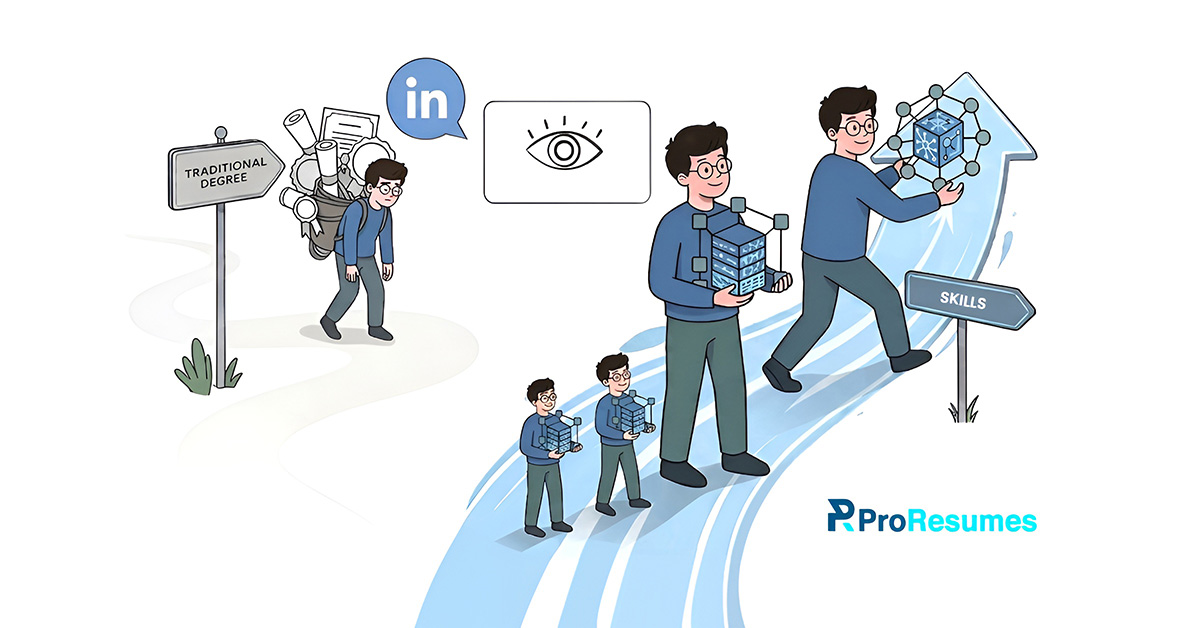
Why Do you Need a Skills-First Approach to Grow your Career?
The World Economic Forum report in 2025 showed that around 39% of the core industry skills are expected to change. Moreover, according to OECD, the labor market of the organization’s members is evolving due to several demographic and industrial factors.
This is the reason why the organization stressed the use of a skills-first approach in 2025. With technological advancements like AI evolution, economic growth requires sustainable work opportunities that are sustainable.
Employers and even professionals have to use a skills-first strategy to counter the evolving skills and talent requirements. This means that the employment landscape needs a cultural shift to transition from traditional practices.
Treat this blog as a guide to learn why the skills-first approach matters and how it will support your career. Moreover, explore skill signaling, skills-first resume, and the use of skills-first hiring.
Don’t forget to check out the benefits as well as the challenges that are closely linked with this approach. Let’s learn why a skills-first approach matters!
Want to learn more about job trends and career shifts in 2026? Explore ProResumes blogs.
What is a skills-first mindset?
The skills-first approach or perspective is defined as a way of talent management that focuses on skills and competencies. Instead of demanding credentials including university degrees, references or work histories.
The approach is an umbrella term that includes processes for attracting, recruiting, or evolving talent. It focuses more on the competencies instead of how they were actually acquired by a candidate.
The focus is shifted from having formal education to more unconventional ways for building skills like:
- Online courses
- Gaining work experience
- Vocational training
The approach benefits both employers and professionals at the same time. It helps the hiring authorities in generating a promising and future-proof talent pipeline.
According to the statistics, around 60% of employers recruit better talent than those who don’t use a skills-first approach. This is the reason why one should invest in skills development to grow in their careers.
What is skill signaling, and how can a professional use it?
In OECD countries, the process of skill signaling is growing evidently as job seekers are investing in self-promotion. It is also considered one of the main components of the skills-first approach.
Moreover, the term skill signaling is defined as the efforts of a professional in utilizing a medium for promoting their skills. They use the skill signals to support their job searches or to grow professionally by building authority. Moreover, skill signaling is mostly used by the following kind of people:
- Professionals who are in the younger age bracket (especially Gen Z).
- Professionals who are often underrepresented, like women.
- Processionals with specific work experience or higher education.
- Professionals who work in the marketing, business, technology, or digital sectors.
Moreover, according to the OECD’s 2025 report, skill signaling helps individuals who usually lack formal education. People who use professional networking sites for skill signaling reduce the employment gap even if they lack a university degree.
What are the main parts of skill signaling?
Skill signaling consists of two major parts: communication and recognition. However, skill acquisition is also known as one of the dimensions of skill signaling, which is related to the other two components.
Here’s how these components help a professional in promoting their skills:
Acquisition: This component is linked with how an individual masters a skill. It is connected with the venue or the medium that is used for learning skills. The mediums can include a university degree or informal online courses.
Choosing the right medium is essential for skill development since the right provider ensures quality and credibility.
Communication: This component of skill signaling is linked with the use of a medium or platform for promoting acquired skills. It includes platforms, documents, networking groups, and sites to reach the target audience.
Now, every tool or platform has specific advantages that are unique to it only. However, if an individual wants their communication to be effective, then they should focus on the following:
- Clearly communicate why you are an expert.
- Choose the right platform or medium for communication.
- Analyze the career opportunities you anticipate through communication.
It is also recommended to explain or communicate your skills through standardized frameworks that are understood by employers. This helps in achieving an efficient level of skill signaling. It helps in not only mastering a skill but also being able to sell it.
Recognition: This part of skill signaling is connected with how an individual provides proof of their credibility. It involves the use of recommendations, testimonials, or professional references to validate your skills or competencies.
This recognition is mostly provided through formal means, which include the following:
- Certifications
- Licenses
- Degrees or Diplomas
The recognition that an individual achieves through the informal modes for skill signaling includes the following:
- Peer endorsements
- Personal statements
- Credibility of the referee
- Credibility of skill trainers or institute
Why is the skills first approach better than the traditional skill signaling?
The traditional method for skill signaling relies on formal means like a university degree or diploma. This means that the applicant relied more on the credibility of the institute where they studied or even previously worked.
Here’s a list of some of the signals used for traditional skill signaling:
- Years of experience
- Career progression
- Educational qualification
- Credibility of the organization
These skills have been used as factors that encouraged the hiring decisions of employers. However, many of these factors don’t really communicate their expertise and often result in wrong recruitment decisions.
The skills-first approach matters because it offers other methods for the acquisition, communication, and recognition of skills. This makes the use of media and signals that support the perspective, such as skill taxonomies and resumes.
What are the skills first mediums that support direct signaling?
The communication medium that are used in the skills first approach for direct signaling are:
- Social networking sites (Eg, LinkedIn, Instagram, Facebook, or YouTube)
- Digital learning and employment records
- Skills-first Resumes (Functional resumes)
What are the signals used for direct skills signaling?
The kind of signals that can be used by job seekers for direct skills signaling are:
- Skills or skill levels explained in skills taxonomies
- Micro credentials
- Tasks involved in previous work experiences
- Course content or syllabus
What is a skills-first resume, and why do you need it?
A skills-first resume is mostly known as a functional or skills-based resume document. It is mostly used to highlight the competencies and skills of a job applicant over their work or educational experiences.
This resume format utilizes the skill categories to explain the abilities of a candidate to employers. Moreover, it is used by the following types of job seekers:
- Those who change their careers.
- Those who have big employment gaps.
- Those who lack work experience.
Main components of a skills-first resume
The main sections of a functional or skills-first resume are the following:
- Contact Information: This section includes the candidate’s name and contact details.
- Career objective or summary: This section is used to highlight their key competencies, achievements, or professional commitment.
- Skills section: It is the core part of the resume document, instead of the work history. Moreover, it should be written using skills categories, bullet points, and quantifiable achievements.
- Work experience: Unlike other resumes, a skills-first resume doesn’t provide details in the experience section. It includes details like a previous position or employer name.
- Education: This part lists the details like the name of the course, organization, graduation year, and more.
- Additional sections: The additional sections often involve hobbies, references, publications, or volunteer work experience.
Getting confused between the best resume format among the skills-first and chronological one? Connect with ProResumes writers for free resume review and to get your skills-first resume at affordable pricing.
What is the skills-first hiring approach?
The skills first hiring approach focuses on recruiting talent due to the alignment of their skills with work requirements. Unlike the traditional hiring models that only focus on work experience or degrees, this approach utilizes skills assessments.
The skills-first HRM approach also focuses on the acquired skills of individuals that can support their whole work experience. Moreover, the broader aspect of this approach shifts from hiring to the whole employment lifecycle and skills assessments to cover gaps.
How does the skills-first approach help in finding skilled talent?
Here’s how this approach is used to find efficient candidates from the labor market:
Gives access to high-income and growth opportunities
Employers should promote this approach by educating their current employees and potential ones regarding skills development. The organizations should offer good income and growth opportunities for skilled individuals to upskill.
Enhances the employee trust and retention rate
The evolution of industries that focus on continuous learning of employees through effective methods promotes employee trust. The organizations that use this method and invest in the skills-based learning of their workforce achieve better employee retention.
Gives access to hidden skilled talent in the labor market
The skill-first hiring approach has shifted the practice of hiring talent based on formal credentials. This approach explains how skills can be acquired without degrees, resulting in the search for and access to hidden talent.
Helps in creating a promising talent pipeline
The traditional system was linked with linear mobility in the career landscape. However, the skills-based talents are exploring this mobility at vertical and horizontal levels, depending on their experience.
Moreover, this approach also helps organizations in hiring talent from within their workforce or from other organizations.
Having a holistic view to fulfil future talent needs
This approach helps business decision makers have a holistic view of the current talent pool and future needs. The informed policies help recruiters, managers, and leaders in achieving organizational goals.
What are the challenges linked with a skills-first approach?
Even though the skills-first approach offers several advantages for economic growth, it still has a few limitations, such as:
The need to conduct a skills assessment
An organization can’t utilize the skills-first approach unless they have proper mechanisms for the identification and assessment of skills. It requires the need and development of assessment tools, strategies, and HR training initiatives.
Enhancing upskilling and reskilling initiatives
The organizations should invest in reskilling and upskilling initiatives that help the workforce adapt to new job trends. This might include investment in online and offline courses, training, or workshops.
Challenging the traditional hiring norms
Adapting a skills-first approach is not easy since it demands an entire cultural shift within the organization. It requires a mindset and strategy to shift from the traditional workplace and hiring practices.
How can stakeholders collaborate to bring the skills-first transition to support economic growth?
The stakeholders, including government, employers, organizations, and skills training institutes, should collaborate for a skills-first transition through:
Encouraging and supporting skills validation
Stakeholders should create standardized systems for the validation of skills to promote employer trust and candidate credibility.
Investment in lifelong learning and skills development
Stakeholders should invest in programs or training systems that are accessible for applicants who lack formal education.
Making informed decisions through labor market data
Policymakers should use the labor market data and job trends to promote skills-based hiring and employment demand.
Promoting skills first hiring in the public sector
Public institutions should invest in promoting this approach by eliminating the demand for formal education for various work opportunities.
Frequently Asked Questions
Q. What are the five stages of skills development?
Skills development is becoming a necessary part of the current job trends in 2026. If you want to benefit from the skills-first approach and hiring, then you must be prepared to work on it.
There are five main stages that support the development of a skill, and you should know how to navigate these:
- Unconscious Incompetence: During this stage, a person is unaware of their potential to learn, the gaps, and their level of competence. According to career experts, to move further, a professional should have a growth mindset.
- Conscious Incompetence: This is the stage where one is aware of one’s own incompetence and wants to fill the gap. However, this stage gets frustrating, but it is essential to grow and refine your competence level.
- Conscious Competence: During this stage, an individual is aware of their competence but needs to give much concentration and time to work. This stage often comes with cognitive loads that can be avoided through continuous learning and repetition.
The practice of working on similar tasks improves the confidence of the individual and eventually helps in internalizing it.
- Unconscious Competence: Once an individual masters a skill, it becomes second nature to them. At this point, a professional isn’t required to give complete focus to the use of a skill. However, it is essential to keep a lifelong learning mindset even after mastery to be able to keep up with industry advancements.
- Innovation: This is a point where the individual has not only mastered a skill to its core but can innovate as well. Innovation is the final stage of skill development where you can use your competence to explore new strategies and perspectives.
Q. Should you put skills first on a resume?
Yes, a job applicant can highlight their skills first in the resume if they don’t have experience or want to cover gaps. These types of functional resumes are also preferred as a communication medium for direct skill signaling.
Q. Is a skills-first approach effective in promoting workforce diversity?
Yes, it is effective since a skills-first approach offers opportunities for the working groups that are the most underrepresented. These groups of the labor market include the following:
- Women
- Professionals without formal education
Q. Does AI technology align with the skills-first approach?
The ever-evolving employment landscape shows that a skills-first approach is essential to tackle the emerging talent requirement. The emergence of AI technology is critical to shift the focus of employers to skills-first hiring from traditional ones.
The organizations that want to evolve with AI and use it for their growth need to invest in skills-first hiring. The economy that is driven by AI needs diversity of talent for the exploration and use of technology.
Q. What are the future-proof skills to grow in the labor market?
The Future of Jobs report in 2025 surveyed a bunch of industries. This survey was conducted to figure out the skills that can help professionals navigate job trends.
The skills that are going to be in high demand for various industries from 2026 to 2030 are the following:
- AI and Big Data
- Cybersecurity
- Creative Thinking
- Lifelong Learning
- Resilience
- Agility
- Flexibility
- Technological Literacy
- Talent Management
- Analytical Thinking
- Social influence
- Environmental stewardship