
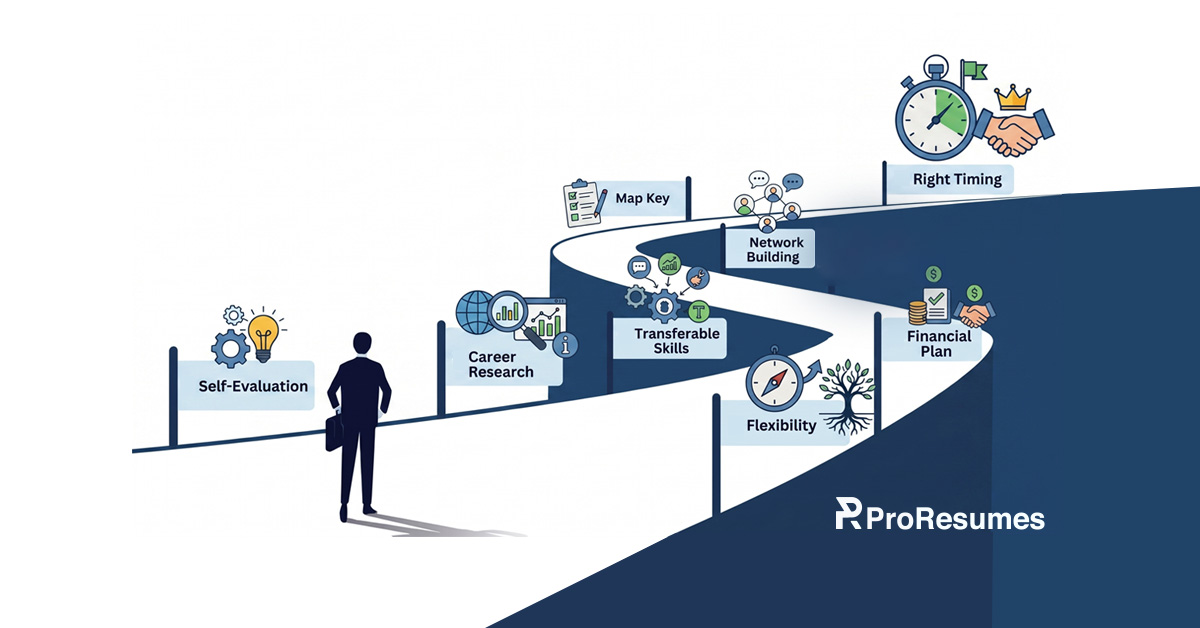
Everything That You Should Know for a Smooth Career Change
Do you know that around 60% of workers in the employment sector are expected to switch jobs or careers? Career change is becoming a common practice in 2026 due to burnout, high income, and greater life purpose.
However, even though on the surface it appears to be an exciting life transition, it can sometimes become daunting as well. If you’re planning a career shift, then you should be aware of the current job trends, financial situation, and some key career change considerations.
This guide will help you understand when and why you need a career transition in life. Moreover, it will guide you regarding the things that you should know for a smooth switch.
Not only this, explore how to switch careers at any stage of life and why people prefer to do it in their 40s or 50s.
If you want to get guidance on the latest salary trends for different careers, then visit ProResumes blogs.
What is a Career Change?
In the simplest terms, a career change is leaving a job or professional career to pursue another. However, when we talk about career switching, it’s not as simple as job hopping and requires upskilling and preparation.
Moreover, a career transition might require the professional to take up internships, training, or work projects. This is to build experience and ensure that a professional can easily fit into their targeted industry.
Moreover, the main goal of a career switch is to choose a work position that aligns with the professional:
- Values
- Career aspirations
- Personal Interests
8 Main Indicators that Highlight the Need for a Career Change
A career switch doesn’t happen overnight! The professionals observe and experience various signs that indicate the requirement for a career transition.
These indicators for career transition include;
Zero Professional Growth
Career stagnation is a phenomenon that often indicates that there is nothing left in a career for professional growth. One can’t have a promising career without the need for skills acquisition, lifelong learning, and facing new challenges.
Career change statistics reported that 70% of individuals change their careers due to the need for professional development. If you, as an individual, find no good reason to focus on your job, then you have likely outgrown it.
Since AI is becoming a significant part of every industry, professionals should focus on gaining AI literacy. However, if their current organizations aren’t investing in their training and upskilling, then they might feel stagnated.
Experienced Burnout
Sometimes, a bit of stress factor is good for a challenging environment in the workplace. However, constant struggle and burnout are only experienced when things are getting out of control.
Professionals mostly experience burnout when there is a feeling of dissatisfaction, a lack of work-life balance, and a constant workload. Moreover, this not only affects the health of a professional but also their work performance, dedication, and critical thinking.
Professionals who experience signs of burnout should switch careers for the sake of their mental peace, happiness, and work quality.
Lack of Alignment with Organizational Values
Professionals and organizations go well only when their values align. The moment a professional’s values start differing from the organization they work for, they should consider a change.
Sometimes the leadership is very demanding, or the organization takes varying decisions that can conflict with a professional’s values. If a professional feels uncomfortable with such values, they should switch.
Professional Feels Unappreciated
Most of the time, professionals who are working hard and giving results feel unappreciated in the workplace. According to Gartner’s 2023 statistics, around 82% of professionals switch careers because they aren’t valued.
Feeling appreciated is considered the biggest factor for increasing an employee’s motivation levels. If a person is constantly disregarded for promotions or career opportunities, then they should likely transition into a different career.
Toxic Work Environment
Did you experience hostile behavior from work colleagues, miscommunication, and micromanagement? Chances are that you might be a part of a toxic work environment.
It is better for a professional to switch jobs or careers if they have to sacrifice their mental well-being or health. The career change statistics report that one in five people switch jobs due to a toxic culture.
Got Better Career Opportunities
Sometimes professionals get unexpected career opportunities that are significant for their growth and learning. Many employees prefer organizational loyalty over promising work opportunities and often miss out.
Professionals who get opportunities with better income, benefits, and learning potential should consider a career change.
Outgrown the Current Role
Some professionals don’t change their careers due to fewer opportunities or being dissatisfied. Most of them leave it because they have achieved everything they desired out of a particular work position or career.
This usually acts as a sign for a career change or a big indicator and motivator for taking on more challenges.
Professional Feels Unsatisfied or Unhappy
The last indicator is usually a feeling of unhappiness while being in your current career. It is significant to assess oneself and figure out the cause of one’s unhappiness to deal with it practically.
Most of the time, issues aren’t visible, and professionals usually depend on their gut feelings. If you find yourself constantly unhappy at your job, then you should take a break and transition into something exciting.
What are the Main Career Change Considerations that a Professional Must know?
Since you’ve understood the signs of a career switch and are gearing up for one, you should check out the major considerations first:
Right Timing
The most important consideration and yet the most ambiguous to detect is the right time to switch careers. There is no pre-written timeline for professionals to jump into another career.
However, they can take the following into account:
- Comfort level: Some professionals only stay in a career because they are comfortable in it.
- Restricted learning: It is not necessary to gain new knowledge every day. However, if a career isn’t supporting your growth as a professional, then it needs to be changed.
- Industry shrinkage: Advancements in AI and technology have evolved many industries while shrinking some as well. If a professional is a part of an industry that is dying down, then a switch in career is necessary.
Career Research
You cannot take a career switch without any solid research. It is important to gather data regarding the following:
- Job postings: Check job postings on online and offline platforms to get a gist of what is highly demanded in a target career.
- Work experience and education: You can’t make it in a different career without the necessary qualifications and experience. Enroll in internships or educational courses to understand the basics of the target career.
- Skills: Assess the skills you already have and compare them with the ones required by the target industry.
Self-Evaluation
Self-assessment is necessary to prepare yourself for a career shift. You need to thoroughly analyze all your interests, values, and competencies to choose a career.
It is important to be aware of your career aspirations and strengths or weaknesses to make informed decisions.
Professionals can also use the following tools to aid their self-assessment:
- CareerLeader (Self-assessment tool)
- Myers-Briggs Type Indicator – MBTI (Personality test)
- O*NET Interest Profile
- MAPP (Motivational Appraisal Personal Potential)
Financial Plan
You can’t switch careers without assessing your current financial situation. The career changers should consider these things before moving forward with a career transition:
- Budget: You have to make a budget and understand all your expenses, including the ones covered by your previous employer. These expenses mostly include car fuel or healthcare.
- Emergency fund: According to career advisors, career changers should have an emergency fund for 6 months to cover expenses. Moreover, it is ideal to have a full-year plan.
- Fix a salary: Use two accounts for your savings and current usage. The professionals should fix an amount, like a salary, to receive from their savings account for monthly expenditure. This will help them avoid overspending their emergency fund or savings.
Transferable Skills
The biggest factor to consider for a fast and smooth career change is to evaluate your transferable skills. They might include time management, adaptability, project management, creativity, and more.
When career changers highlight such transferable skills in their resumes, CVs, or interviews, they are perceived as committed.
Networking and Connection Building
When we talk about career switches, it is difficult to achieve without good networking. It is important to network with professionals in your target career through industry events, online portals, or LinkedIn networking.
Networking not only helps in gaining critical industry insights but also offers informational interviews and recommendations.
Flexibility
Flexibility is a core trait that is required from a career changer. It is important to understand that the transition is never always smooth and requires lifelong learning and adaptability.
By having a growth mindset and a spirit to tackle challenges, a career changer can easily navigate through a transition.
Why Do People Mostly Make a Career Change in Their 40s or 50s?
According to statistics, 38% of professionals are reported to be satisfied and successful after a career transition in their 40s. However, the following is a list of some major reasons that explain why such people switch careers:
They want control.
The median employee tenure during this age bracket is around 7.6 years, according to 2020 statistics. However, this tenure is way more than the tenure for people in their 20s or 30s.
Still, many people in their 40s prefer changing careers due to the need for control over their professional life. As a professional grows, they require self-authority to deal with many professional matters.
This need for control is due to the world and life crisis, and alignment of personal and professional goals.
They don’t want to make more sacrifices.
The kind of work they are engaged in isn’t more valuable or fulfilling than the things they have to sacrifice. It is also connected with a lack of professional growth, promotion, or learning at the current job and career.
They have a bigger purpose
Many individuals focus on having a greater purpose in life when they are in their 40s. These goals and purposes were never a part of their professional life during their younger years.
However, during this phase, professionals are more compelled towards bringing a bigger change or making a positive contribution to society. This urge to do something impactful helps in a realization that one can’t achieve it with the current position.
Their field is changed
Job trends in 2026 have drastically changed, with an expected decline of 92 million jobs by 2030. Due to AI advancement, many careers have changed and require minimal human cooperation.
This is the reason why many professionals in their 40s and 50s prefer transitioning to different careers.
They are not much valued
Many people in the age bracket of 40 to 50 face mistreatment at the workplace which makes them switch careers. This mistreatment often results in the form of career stagnation, toxic employees or supervisors, and more.
They experience psychological development
People enter a new brain development stage in their 40s. Due to this, people are more critical of their work, opportunities, benefits, and purposes.
Many people focus more on the significant things after reaching 40 since they have less time ahead of them.
Many professionals invest in making an impact on society, while others focus more on caring for their loved ones.
How to change careers at any stage of life?
Here’s a quick step-by-step guide to help you plan your career change:
Assess yourself
Professionals often romanticize the idea of changing careers due to boredom or repetitive work. They often daydream about choosing a different career or starting a new business.
However, it is important to consider your professional status, personal goals, and finances before making a big decision.
Set a Timeline
Create a potential timeline linked with your career leap. This helps you avoid uncertainty, fear, and procrastination. Moreover, it allows the professional to work in the right direction.
Find and Research the Career
During this phase, one should research careers that align with their skills, values, and personal interests. According to Linda Spencer, career changers can do this by:
- Talking to professionals in the same industry.
- Attending seminars, conferences, or events.
- Check out the Occupational Outlook handbook.
- Read articles and online publications related to the target industry.
Upskilling and Continuous Learning
It is important to create a bit of authority in the target industry before making your switch. Professionals can do this through upskilling by taking certifications from authentic platforms like Udemy or Coursera.
Prepare your tools
At the end, the career changers should have the following items optimized according to the target industry:
- Career transition resume
- LinkedIn profile
Explore ProResumes to find the best way to optimize LinkedIn profile to attract recruiters from the target industry.
What is a Career Change Resume?
A career change resume is used to highlight the transferable skills or limited work experience for the industry you switched to. This career document either follows the functional or hybrid resume format.
Moreover, it has the following main sections:
- Contact Information
- Professional Summary/ Career Objective
- Skills Section
- Work Experience Section
- Education Section
How to Prepare a Career Change Resume with No Experience?
Most career changers don’t have work experience. The following are some points that they can highlight within their resumes:
- Transferable skills: Highlight your transferable skills that are mostly required in the target field.
- Add new qualifications: Career changers need to pursue educational courses or certifications to switch careers. A job applicant can highlight all relevant education.
Still unsure of how to start working on your career transition resume? Get expert help from ProResumes by exploring their resume writing bundles.
Are you Really Prepared for a Career Change?
Even though the idea of a career switch is promising, it might take years for professionals to train before being able to transition. Moreover, a career changer is not always promised a valuable role after a switch, which is the biggest drawback.
Sometimes, the professionals experience a dip in income after a career change as well. It is significant to explore and research all possible situations linked with a switch before making one.
Frequently Asked Questions
What is the Easiest Career to Transition Into?
There is not a single career that is easier to transition into because of its own requirements. However, here’s a list of some careers that career changers can explore in 2026:
- Freelance Writing
- Healthcare Coaching
- Social Media Management
- Digital Marketing
- Data Analyst
- Financial Planner
- Market Research Analyst
- Realtor
Is 30 Years Too Old to Change Careers?
No, instead, the age of 30s in a professional’s life is known as the ideal time for a career change. According to statistics, 80% of employees who are usually in the age bracket of 40 to 55 have switched careers.
Age doesn’t really matter when you consider a career switch. However, things like skills, financial planning, networking, and more should be considered by a career changer.
What is the 30-30-30 Rule for Career Change?
If you’re someone who is stuck in the wrong career and feels miserable about it, then you should change careers. However, jumping from one career to another isn’t an easy task and should be dealt with by using the 30-30-30 rule.
This rule supports a career change without much interruption in the professional’s life. It works like this:
- You should give thirty minutes of your time daily to the exploration of the career you want to transition into.
- You need to invest another thirty minutes daily into upskilling for the potential career switch.
- You need an additional thirty minutes daily for networking with the professionals in the target industry.
By using this framework and 120 minutes a day, you can prepare yourself for a smooth career change.