
Structural Engineer Salary and Career Roadmap
53,475 structural engineers are currently working in the US, and they are the most in demand in Houston. LinkedIn lists more than 5,000 structural engineering jobs for US residents.
Moreover, Glassdoor shows more than eight thousand vacancies for structural engineers in the US.
Love solving mathematical equations and science problems? If so, then structural engineering might be a career for you!
In this guide, we will discuss the structural engineer’s salary, career roadmap, certifications, and skills.
Let’s find out if structural engineering is a good career match for you!
Interested in building your career? Check out our expert advice on trending careers for 2026.
Average salary of a structural engineer on a yearly basis
The structural engineer salary in the US is up to $81,459 on a yearly basis, according to industry estimates. The annual salary of structural engineering professionals can be increased with commissions up to $17,000.
Moreover, structural engineers in the US leverage salary benefits like bonuses of almost $11,000 per year. The structural engineer’s salary for entry-level employees is nearly $70,000 on an annual basis.
However, the growth trend has shown a 14% decline in average salary rates for professionals with less experience. Structural engineers with more than a year of work experience get $76,000 per year.
Moreover, the structural engineer’s salary for senior experts with more than twenty years of experience is $125,000. The growth trend for experienced structural engineers witnessed a sharp 54% increase.
The structural engineer’s salary for professionals with more than a decade of work experience is $102,000 per year. The growth trend for their annual income also observed a 25 percent increase.
What are the structural engineering job obligations?
Structural engineers are professionals who focus on ensuring the structural integrity of any project they work on. They focus on environmental conditions like earthquakes, storms, and gravity to build structures that are sustainable.
The main focus of these professionals is on hazard management by building strong and secure structures like roads and bridges. Structural engineer’s jobs include collaboration with stakeholders, civil engineers, architects, and more.
The job obligations of a structural engineer typically include:
- They calculate and analyze the safety of a structural design.
- Structural engineers use mathematical models and engineering software for analyzing the load capacity and structural stability.
- They stay updated regarding structural regulations and building codes to create structures that are compliant.
- They show teamwork and collaborate with architects to ensure the safety of beautiful structural designs.
- Structural engineers oversee the construction of these structures to ensure that they follow the project guidelines.
- They plan the budget of a project by analyzing expenses for the team, material supplies, and more.
- They conduct thorough risk assessments to test the sustainability and quality of a structural project.
- They prepare structural design documentation and create analysis reports.
How to become a structural engineer with or without a degree?
The well-known career roadmap for structural engineers requires a degree. Here’s how you can start your structural engineering career if you wish to pursue a degree:
- The structural engineers are required to earn a four-year degree in mathematics or engineering. However, you can also obtain a master’s degree to strengthen your engineering knowledge.
- These individuals are required to clear the fundamentals of engineering (FE) examination after or during their degree.
- Once structural engineers are done with their education, they take part in internships to receive hands-on industrial training. They mostly work under a certified structural engineer to develop their professional expertise.
- Structural engineers are required to earn professional engineering (PE) licensure after education or during the training period.
- Having necessary structural engineering certifications helps these professionals enhance their income. The required certifications include:
- Certified Construction Manager
- Project Management Professional Certification
- Geotechnical Engineering Certification
- Structural Engineering Certification
- LEED Accredited Professional
If you’re interested in the non-degree career route, then getting a professional structural engineering designation is difficult. Since structural engineers are required to stay compliant with structural regulations, academic education is essential for them.
However, you can still work in the structural engineering field without a degree.
The options for working in different designations within the structural engineering field are:
- Modeling Specialist: These professionals turn the vision of a structural engineer into drawings, blueprints, and more with software like Auto CAD.
- Structural Engineering Technician: Such technicians work with certified structural engineers and take care of site testing, design technicalities, and more.
- Construction Inspector: These engineering professionals ensure the quality of the structures according to the approved designs.
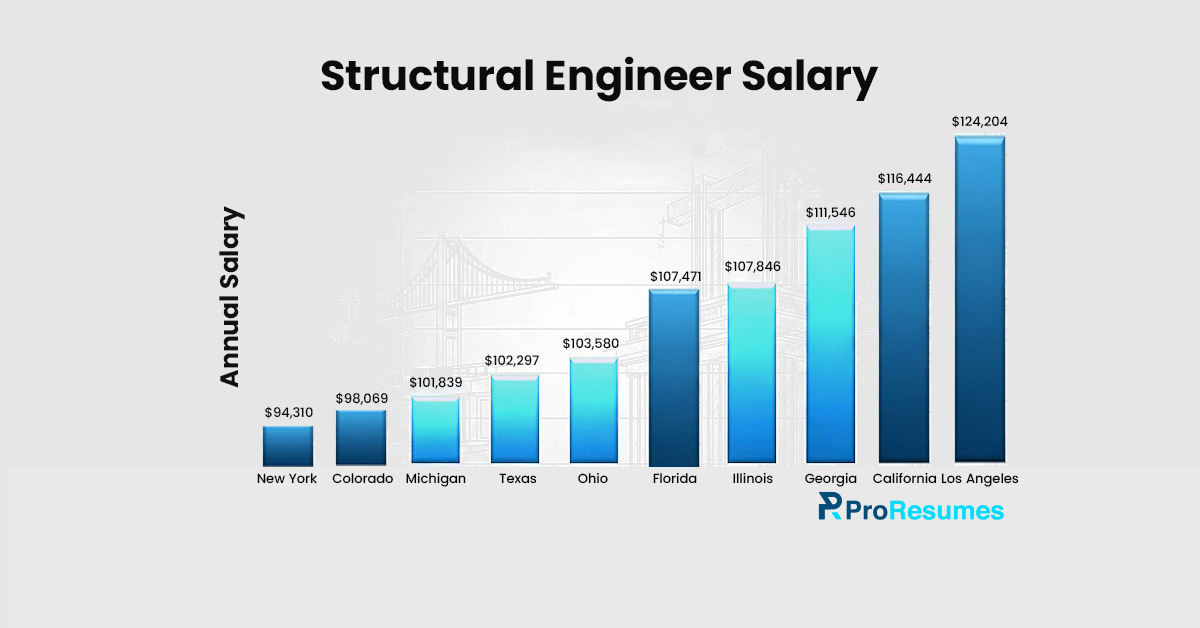
Structural engineers’ salary by state according to annual criteria
The structural engineer’s salary in the state of Ohio is almost $103,580 per year.
Meanwhile, in the state of Colorado, the structural engineers earn $98,069 on an annual basis.
The structural engineers working in Georgia earn around $111,546 a year. Engineering professionals in the structural engineering field typically make up to $100,096 per year in Washington.
The structural engineer salary in Los Angeles is $124,204 per year, and apparently the highest among all the states. The structural engineers residing in Texas earn up to $102,297 annually.
The structural engineer salary in Florida is around $107,471 on an annual basis. Meanwhile, such engineering experts earn around $94,310 a year in New York.
The structural engineers based in the state of Illinois make up to $107,846 per year. Whereas the structural engineer salary in Michigan is around $101,839 annually.
The annual structural engineer salary in California is around $116,444. Moreover, in Chicago, structural engineers earn around $110,739 per year.
| State Name | Structural Engineer Salary |
| Texas | $102,297 |
| New York | $94,310 |
| Michigan | $101,839 |
| Los Angeles | $124,204 |
| Illinois | $107,846 |
| Colorado | $98,069 |
| California | $116,444 |
| Georgia | $111,546 |
| Ohio | $103,580 |
| Florida | $107,471 |
| Chicago | $110,739 |
| Washington | $100,096 |
Salary by country for structural engineering professionals
The structural engineer salary in Spain is apparently 41 percent below the average yearly earnings of US professionals. The structural engineers earn up to €41,271 on an annual basis in Spain.
The structural engineer salary in Qatar is around QAR 10,028 per year. However, the annual income of structural engineers according to the Qatari currency is 97% less than in the US.
The structural engineers in the United Kingdom make up to £33,746 as per yearly estimates. However, their income is still 45.3% less than the income of such experts in the US.
In Australia, the structural engineer salary is almost AU$80,360 according to annual estimates. However, the structural engineer’s yearly income is 36% below the average annual income in America.
The structural engineer salary in Canada is up to $92,865 per year. Such engineering workers earn 19 percent less than Americans.
The structural engineers in Norway make up to 549,634 Norwegian krone a year. Still, the structural engineer salary observed a 39% decline when compared to the US.
| Country | Structural Engineer Salary |
| Spain | €41,271 (41% Lower) |
| Qatar | QAR 10,028 (97% Lower) |
| United Kingdom | £33,746 (45.3% Lower) |
| Canada | $92,865 (19% Lower) |
| Australia | AU$80,360 (36% Lower) |
| Norway | 549,634 kr (39% Lower) |
Must-have professional skills for a structural engineer
The structural engineers are the masterminds behind towering buildings, beautiful and safe bridges, and other physical infrastructure. These engineering professionals acquire sharp mathematical, constructional, and scientific knowledge along with a variety of other skills.
The skills of a structural engineer include people management and professional skills, such as:
- Autodesk AutoCAD
- Microsoft Excel
- Technical Knowledge
- Problem-solving
- Compliance and Regulatory Knowledge
- Cost Estimation
- Communication
- Teamwork
- Client Interaction
- Project Management
- Finite Element Analysis
- Construction
- Project Management
- Structural Analysis and Design
- Risk assessment
- Building information modeling (BIM)
- Safety Management
- Knowledge of Blueprints
- Quality Control
- ANSYS Simulation Software
Is your structural engineering resume rejected by your desired workplaces? Chances are high that it might be failing because of the ATS scans.
Structural engineering work environment
Structural engineers work at construction sites or within office settings. The professionals who work in office settings play the role of consultants and work for forty hours a week. They typically deal with project management, blueprints, and engineering software and tools.
Meanwhile, the structural engineers who work at construction sites are typically known as contractors. These engineers oversee the development and maintenance of projects. They collaborate with other development teams or even lead them to ensure project quality.
Frequently Asked Questions
Q. How much do structural engineers make in a month in the US?
The structural engineer’s salary in the USA, as per monthly income estimates, is around $7,430.
Q. What is the difference between structural engineers and architects?
The major difference is that the architects focus on the aesthetics and visual appeal of a structure. Meanwhile, structural engineers focus on the sustainability and safety of the structures.