
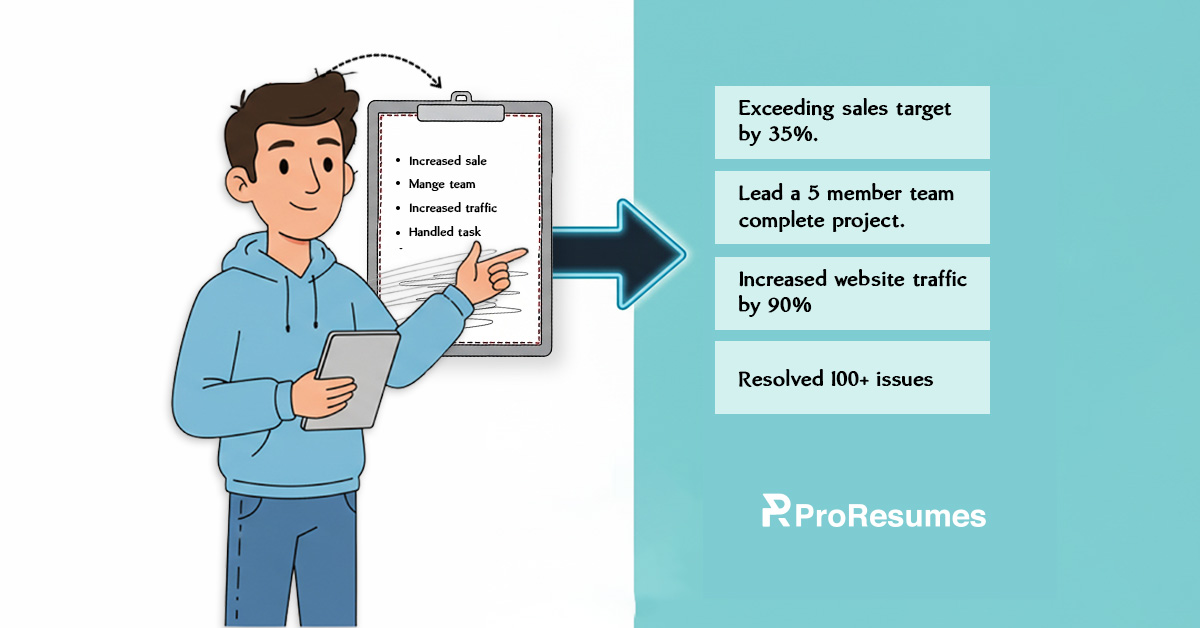
Transforming responsibilities into quantifiable achievements on resume
Are you still listing your professional tasks in resume bullet points and wondering why you aren’t getting hired? If this is you, then you really need to reconsider rewriting your resume, because the current one isn’t good!
You need to understand that a recruiter doesn’t spend more than 9 seconds on your resume. In this short glance, resumes that focus on representing quantifiable achievements get an edge over resumes filled with task descriptions.
In this guide, we will discuss the significance of using quantifiable achievements in a resume. We will share the advantages, metrics, formulas, examples, and an easy-to-follow, how-to guide for quantifying achievements.
Are you interested in enhancing the worth of your resume by adding measurable achievements? Let’s explore.
Are you struggling in choosing an effective career because of millions of varying views and opinions in this digital era?
We understand your struggle and offer comprehensive career advice by certified career coaches on ProResumes.
What is the significance of using quantifiable achievements in a resume?
Quantifying your achievements helps you in demonstrating your unique value proposition to the recruiter. Moreover, we’re living in the age of AI, and almost every recruiter is using an Applicant Tracking system.
Your resume can never pass the ATS scanning until it presents concrete evidence of your expertise. A recruiter is always going to hire a job applicant who presents quantifiable achievements over someone who lists their responsibilities.
It is important to understand the difference between adding responsibilities and achievements in your resume. Resume bullet points with responsibilities only state the tasks that you performed at your previous job.
Think of it like stating the obvious: a hiring manager already knew the job duties connected with your role. You don’t need to share them!
Instead, if you add achievements to your work experience section, you’re telling the recruiter, “Why should they hire you?”
Quantifiable achievements on your resume help in presenting how well you performed during those assigned job duties.
What are the advantages of quantifying your achievements?
We’ve discussed the importance of using quantifiable achievements in a resume to make an impression. However, if you still feel skeptical about quantifying your achievements, read the following advantages:
It builds credibility
When you use quantifiable achievements to explain the impact of your professional contributions, you build credibility. It tells the recruiter that you aren’t making baseless claims by using resume buzzwords or fluff.
Moreover, it also tells them about your professionalism and interest in the opportunity by figuring out and providing concrete data.
It demonstrates your value proposition
An employer won’t understand the value you can provide with a vague statement like “led a team”. However, when you quantify it by stating, “led a team of 50 people and increased sales by 75%,” You’re concretely demonstrating your expertise.
By providing the tangible outcomes, you’re giving them a clear idea of the results you can deliver for their organization.
It displays your result-oriented nature
The quantifiable achievement in your resume clearly gives the recruiter an idea of your priorities. It helps them in realizing your potential as a result-oriented professional who focuses on outcomes rather than tasks.
Moreover, quantifying achievements in a resume is important for result-oriented professions that rely on metrics for decision-making. These industries include marketing, sales, leadership, and more.
It gives you an edge among fellow applicants
Many organizations use the applicant hiring process with several assessments and interviews. Using quantifiable achievements in your resume helps you make an impression with numbers, eventually moving to other rounds.
Moreover, the majority of job applicants submit their resumes without tailoring them to a specific job. This instantly gives benefits to the resume with tangible results to stand out among the competitors.
It helps you in passing the ATS scan
When you use quantifiable achievements, you use action-oriented words or industry-specific keywords to write resume bullet points. This helps with increasing the Applicant Tracking System (ATS) score of a resume by following the keyword criteria.
Don’t know how to create quantifiable resume bullets that can pass the ATS scanning? Check out resume writing services by ProResumes that promise high ATS scoring.
What are the resume metrics that are used to define quantifiable achievements?
We’ve covered the advantages and significance of using quantifiable achievements in your resume. However, you cannot quantify your performance by using plain numbers.
It is important to use metrics that focus on providing evidence for your data-driven resume bullet points. These metrics are mostly known as key performance indicators (KPIs) and describe how business objectives are achieved.
Here’s a list of common metrics that can be used in a resume to quantify achievements according to the target role:
Operational metrics
The operational metrics are used to provide quantifiable results in terms of the following measurables:
- Production volume
- Efficiency gains
- Process improvement
- Time Managed/Saved
Job applicants can utilize these metrics to highlight the operational efficiency of their previous organization due to their work.
Financial or Sales metrics
Why do companies hire you? It’s simple; they’ve hired you mostly for monetary gains. You’re either saving them money or helping them make money.
Mentioning financial figures on your resume instantly grabs the attention of a recruiter. You can use dollar amounts to express quantifiable achievements in a resume by highlighting the following:
- Revenue generation
- Budget management
- Sales generation
- Cost-saving
Marketing metrics
Marketing is a result-oriented job and requires concrete evidence of previous work in your resume. You can use the following measurables to quantify past achievements in your resume:
- Conversion Rate
- Lead Generation
- Return on Investment (ROI)
- Website traffic
- Followers’ growth
- Subscribers’ growth
Performance or Ranking metrics
Most industries use performance or ranking metrics to calculate the achievement of business objectives. Moreover, these metrics represent individual as well as team roles.
Job applicants who are interested in using quantifiable achievements in their resume can use the following metrics:
- Target Progress and achievement
- Employee Ranking
- Customer Satisfaction score
- Website and SEO Ranking
People or Volume metrics
Many roles involve people in management, such as leadership, hiring managers, and more. If your target job requires you to manage people, you can easily use the following key metrics:
- People Hired/Managed
- Clients Management
- Team Performance
- Retention Rate
- Acquisition Rate
Project metrics
Many jobs work on tasks or project basis, such as contracts or project management. If you’ve past work experience as a project manager, then you can use the following metrics to share impacts:
- Number of Projects
- Project Success Rate
- Project Completion Rate
- Project Size
Formulas to transform job duties into quantifiable achievements
Transforming job duties into quantifiable achievements isn’t an easy task if you’re a beginner. However, there are templates and widely used formulas that you can apply to quantify your achievements easily.
Simple formula for quantifying results
The simplest template to add quantified achievements in your resume is:
[(Action word) + (Responsibility) + (Measurable result)]
You can quantify your performance by using action words to express what you did. It is highly advised to use strong verbs such as the following:
- Streamlined
- Accelerated
- Saved
- Optimized
- Delivered
- Exceeded
- Generated
- Improved
- Reduced
- Developed
While writing, your responsibility is to ensure that you’ve clearly described your duty, the context, and why you did it. Your bullet should clearly specify your role to the recruiter.
Moreover, when you’re stating the results, make use of the following to quantify them:
- Time Frame
- Dollar Amount
- Value
- Percentage
- Numerical Data
Turning problems into results
Most of the roles demand an applicant’s problem-solving abilities. You can use this easy-to-use template for expressing problem-solving skills while quantifying achievements:
[(Problem) + (Action) + (Result)]
- When applying this formula, use the problem component to explain a struggle or issue you identified and provide context regarding it.
- While describing the action, focus on addressing how you resolved the issue by addressing a particular process.
- Finally, always quantify the results you achieved by resolving the issue with numbers, percentages, or other key metrics.
Quantifying results with the STAR method
The STAR method is generally used for answering behavioral questions during interviews. However, you can apply this method to present quantifiable achievements in your resume as well.
The STAR method is typically an acronym for:
- S: Situation
- T: Task
- A: Action
- R: Result
Add the context regarding the professional experience while focusing on the situation. While describing the Task from the STAR method, focus on your duty in that specific context.
Focus on describing your process in detail while describing the Action part. Lastly, quantify the results you achieved from your process and efforts in the form of key metrics.
Define impacts by stating challenges
Last but not least, you can use the following template to address quantifiable results in your resume.
[(Challenge) + (Action) + (Outcome) + (Impact)]
Describe the business goal or difficult situation that you identified. Focus on adding details about “what exactly did?”
Once you’ve addressed the tangible outcomes that you achieved from your specific action, highlight the impact it created.
How to quantify your job duties into achievements?
We’ve discussed the significance of quantifying achievements in resumes, covering their advantages and templates. Let’s explore how you can add quantifiable achievements to your resume by yourself.
Understand the Importance
The most important part is to identify the difference between responsibilities and measurable achievements. The purpose of the resume is to inform the reader about something they aren’t aware of.
Quantifying your achievements answers their questions regarding what you can do for their organization.
Track the Results and impacts
The most important thing is to keep track of the results you achieved and the impact you created on your previous job. Do this by keeping a journal or diary to add all your important job records on a weekly or bi-weekly basis.
This helps you save time while applying for a new job. Moreover, it also helps you with storing important details for later use, even if you forget them.
Brainstorm to gather data
If you haven’t kept a record of all your previous professional achievements, start by analyzing the key metrics. Gather your data by ensuring the business objectives of your target job and your previous job duties.
Moreover, the easiest way is to use your previous job title by converting it into action verbs to quantify achievements.
Use Numerical ranges
While accurate data is ideal for quantifying your achievements, it is not necessary to rely on it every time. However, many people lack accurate data or numbers to quantify their results.
Moreover, sometimes your specific results don’t align with a recruiter’s objectives and requirements. Highlighting the results might get your application disapproved as well.
You can use a range to describe a certain estimate that is open to interpretation. For example, a customer service employee can share that they deal with 50 to 100 customer calls a day.
State the Key performance indicators
Express the positive impact of your results on the business by mentioning money, people, performance, or other metrics.
Proofread your Claims
Make sure to proofread your resume submission and verify all the quantitative data to maintain your integrity.
How to quantify achievements for freshers, career changers, and other professionals?
Here’s how you can refine your resume with quantifiable achievements regardless of your position, experience, or other things:
Quantifying achievements for Entry-level employees
Entry-level employees often worry about quantifying their achievements because of their lack of experience. Here’s how you can add measurable data in your resume:
- Add your internship experiences.
- Add academic achievements or projects related to your target job.
- Address your improvement during your work.
- Add any project that demands similar skills.
Quantifying achievements for Students
Students can add the following elements to their resumes:
- Add your skills and address your proficiency in them, along with examples of application.
- Add any kind of experience you had during your studies. Be it volunteer work or extracurricular projects.
Quantifying achievements for Career changers
Career changers who are often worried about having no relevant experience can use the following:
- Focus on people’s management skills that are required in every area, like negotiation, leadership, and more.
- Identify and add your transferable skills along with the tangible results.
- Add your certifications or licenses that can provide value.
Quantifying achievements for Professionals with zero metrics
The majority of jobholders can’t mention quantifiable details in their resumes because their jobs can’t be quantified. Such job seekers can use the following ways:
- Add the type of contributions they made during Teamwork.
- Add performance reviews or employer feedback.
- Add the frequency of duties/clients/customers you managed.
If you’re one of the above candidates who finds it difficult to quantify their achievements, contact ProResumes.
Examples for Quantifying achievements in a resume
Here’s a list of some examples of quantifiable achievements within different industries:
Sales
- Developed strong relationships with clients, exceeding sales target by 35%.
- Generated 50 engaged leads per week, increasing acquisition rate by 20%
Education
- Managed 5 grades for six months with a number of 50 students each.
- Developed a curriculum to improve students’ success rate in examinations by 90%.
Marketing
- Increased website traffic by 90% through technical SEO, leading to 75% revenue generation.
- Managed brand social networking handles, increasing the audience engagement rate by 60%.
Information Technology
- Implemented security strategies, reducing 60% of security incidents within a year of staff augmentation.
- Managed mobile application development project, delivering product within due date, saving 15% budget.
Human Resources
- Implemented employee satisfaction strategies, enhancing retention rate by 30%.
- Managed staff training workshops, improving employee productivity by 16%.
A resume with quantifiable achievements stands out
According to a Healthcare leader on LinkedIn, “Quantifying impact sets you apart, numbers speak louder than words,” and we agree.
Resumes with quantifiable achievements not only stand out but let you demand the career progression of your choice.
Frequently Asked Questions
Q. What are qualitative and quantitative achievements?
Quantitative achievements are often used to describe measurable accomplishments or tangible data. Quantifiable achievements are mostly represented in the form of numbers, percentages, and metrics. These achievements can be listed in resumes to show the concrete results of your work.
Meanwhile, qualitative achievements are often expressed in the form of intangible data. They are based on interpretations, analysis, and opinions. Qualitative achievements can be used in resumes in the form of soft skills.
Q. What does it mean to quantify your performance?
Quantifying your performance means analyzing and providing measurable achievements to highlight your efforts. You can quantify your performance by deciding key performance indicators (KPIs) that are related to your role and organization.
These KPIs help you track and analyze your contribution according to your expertise and your employer’s expectations. Moreover, you can easily search for these metrics within your performance reviews, supervisor feedback, or job description.
Q. How to keep track of all your contributions at your job for quantifying achievements?
The best way to keep track of your quantifiable achievements is to have a journal. You can keep this journal to jot down all the details about your workday. Moreover, you can list the new tasks or the contributions you added on a daily basis.
This will help you in gathering all your data in one place to use later for writing a resume. Not only this, but you can also use it to write self-assessment reports or to provide concrete evidence of your work.
Q. Is it necessary to include percentages in a resume?
You can use numerical data, percentages, or financial figures to present quantifiable achievements in your resume. However, it depends on the kind of result and context you’re providing.
Sometimes, recruiters are repelled by certain quantified data because that doesn’t align with their indicators of good performance.