
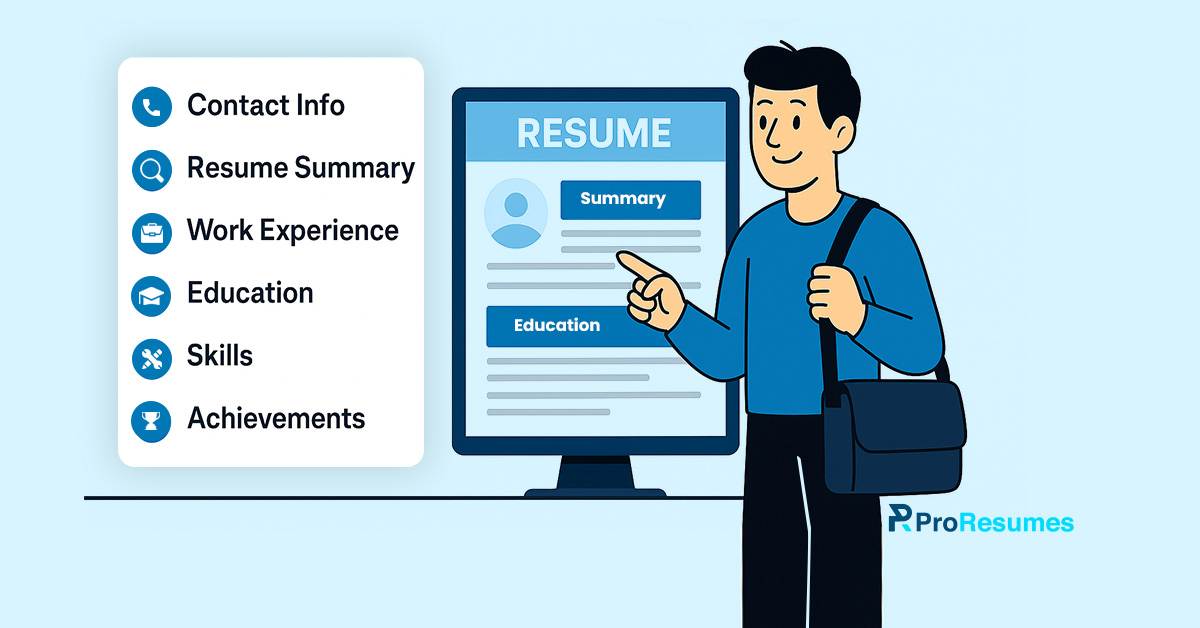
Impactful parts of resume that you must utilize
Parts of resume or resume sections make up the entire structure of your resume and contribute to its effectiveness. Ever heard about the 7-second resume rule? Well, this is the amount of time that decides whether you’re getting an interview call or not.
Job seekers must focus on the parts of their resume if they want to conquer the 7-second rule.
Want to figure out the parts of a resume?
Let’s explore the main and additional parts of a resume or resume sections together!
Moreover, learn how to use these parts of a resume to structure it properly.
What are the parts of a resume?
Resume sections or parts of the resume are used to make the recruiter’s 7-second glance an opportunity for the candidate. These resume sections are used to highlight crucial details about a candidate and their career story in an organized manner.
Think of your resume as a personal advertisement and the parts of the resume as the benefits shown to the audience. The effectiveness of the parts of the resume helps recruiters in deciding whether a job seeker is fit for the role.
What are the main components of a resume?
Every job seeker must include the following parts of the resume while creating one, such as:
- Contact Information: This is the topmost section of a resume and is situated along with the header that displays your name. In this part of the resume, candidates are required to provide authentic contact details.
The contact details for this part of resume include:
- Phone Number
- Email Address
- LinkedIn profile
- Personal Website
- Other Social media handles (if required)
- Residential Address (if required)
- Professional summary or objectives: The professional summary or resume objectives are listed below the contact information.
A professional summary is used to highlight key skills, achievements, years of experience and metrics of an experienced candidate.
Meanwhile, resume objectives are used by students or career changers who lack work experience. These objectives highlight the ambition and vision of the candidates.
- Professional experience: This resume section is the main and most required part of a resume. In this section, job seekers list their past work experiences in detail. They highlight their past employers, years they’ve worked, and crucial metrics to enhance their resume’s worth.
- Skills set: This part of a resume is used to highlight your most prominent skills, divided into hard skills and soft skills. The resume skill section format should be organized in a way that grabs a recruiter’s attention.
Resume writers and career coaches recommend that job seekers highlight the situations where they used their skills. This is a unique and effective way to format a resume skill section.
- Education: This part of a resume is used to show the hiring expert whether a candidate is capable of the role. This is a crucial resume section for students and freshers who lack certain work experience.
Job seekers can use this resume section to highlight their educational institutions, graduation dates, and degrees. Job seekers with no experience can highlight their GPA, coursework, and projects relevant to a job.
Additional parts of resume
Add these additional parts of a resume to enhance its effectiveness, but tailor your resume according to the job:
- Certifications and Awards: If you’ve any certifications that are relevant to the job you’re seeking, add it to your resume.
- Hobbies: Students or career changers can utilize this resume section to highlight the transferable skills they developed through their hobbies.
- Extracurriculars or internship: Use this part of a resume to highlight transferable skills, volunteering, or internship opportunities. You can use this part to highlight leadership or management qualities as well.
- Projects or Coursework: Inexperienced job seekers can use this section to add degree projects that are relevant to their job.
How to properly structure a resume?
Structure a resume with different formats
Job seekers can use the following resume formats to structure them properly:
- Reverse chronological resume format
- Functional resume format
- Hybrid or combination format
How to structure resume sections for experienced job seekers?
Experienced job seekers should focus on their professional experience and use a chronological resume format to highlight and structure. Parts of a resume for experienced job seekers:
Contact information – Professional Summary – Work experience – Skills – Education – Additional parts of resume
How to structure resume sections for students or freshers?
Students, freshers, and career changers should use the functional or combined resume formats to highlight their skill set. Parts of a resume for students, freshers, and career changers:
Contact information – Resume objectives – Skills – Education – Work experience – Additional parts of resume
Structure parts of a resume for the Applicant Tracking System (ATS)
The earlier-mentioned resume formats are standard and work well with Applicant Tracking System (ATS).
ATS is used to remove a big chunk of work from a recruiter’s shoulders by screening hundreds of job applications.
Need a hand to structure your resume according to the Applicant Tracking System’s (ATS) standards? Get in touch with certified resume writers at ProResumes to get that resume magic.
What are some red flags or resume mistakes that you should avoid as a job seeker?
Job seekers should avoid these red flags to improve the effectiveness of their resumes:
- Avoid sending the same and generalized resume to every company. Tailor your resume for better results.
- Avoid using buzzwords or fluff. Try to be concise and specific.
- Avoid spelling or resume formatting errors. Always proofread before submitting your resume.
- Avoid inconsistency in your personal, professional and educational data.
- Avoid being too wordy. White space in your resume is important to enhance the readability rate.
- Avoid using outdated contact information.
What part of the resume should stand out the most?
Your resume is made up of a bunch of main parts that contribute significantly to its effectiveness. However, there are parts of a resume that should be a job seeker’s focus to highlight their worth. Resume writers at ProResumes recommend job seekers to iterate their entire resume regularly, but focus more on the work experience.
The work experience section is the main highlight of any resume, and most recruiters hire people according to their experience.
Frequently Asked Questions
Q. What are the five main sections of a resume?
The five main parts of a professional resume are:
- Contact Information
- Professional Summary
- Work experience
- Skill set
- Qualification
Q. Which format do most employers prefer for resumes?
Hiring experts or recruiters prefer resumes with a chronological format. In this format, the work experience of a candidate is highlighted in a reverse chronological order.
In this way, the most recent and relevant experience is mentioned at the top of a resume.
Q. How many bullets should I have under a job on my resume?
Ideally, job seekers should use 2-3 bullets to describe their key skills, roles, and achievements during work experience.
Experienced clients with years of experience can add more bullets depending on their resume length.
Q. When should you remove old jobs from your resume?
Job seekers should tailor their résumés according to the job description of the target job. It is better to remove irrelevant old jobs or work experience if they lack value and clutter the page.