

What Do You Call It? CV or Resume?
Whether you call it a CV or Resume depends on who you are, where you are from, and where you are applying. A Curriculum Vitae (CV) and a resume have different writing standards, including formats, career professions, and targeted industries. You can’t land your dream job just by changing the document name from CV to Resume and vice versa. Both are completely different in terms of strategy.
The world is divided into two types of English writing standards: American English and British English. Wherever U.S. English is the standard, we name the career document a Resume. On the other hand, we call it an International CV where British English is the standard.
The race is not CV or Resume. The real difference lies between North American Resume or CV writing standards and the rest of the world. Therefore, you need to understand the document standards for Resumes and CVs in North America as well as the overall standards in the rest of the world.
Don’t know what the major differences are between a resume and a CV? When to submit a CV for a job application? What areas do you need to highlight in a resume instead of a CV? Don’t take a single step in your career development and job hunting process without learning from an expert.
Learn the difference between CV and Resume and how to write an academic CV to thrive in 2025 with ProResumes’ Do it Yourself (DIY) resources, certified professional resume writers, and digital career strategists.
What You Need to Learn Before Calling It a CV or Resume?
The labor market for professionals and recent college graduates is changing due to the involvement of AI. The wrong name of your professional document can lead to application rejection in today’s highly competitive job search market. Both a resume and a CV are used to apply for targeted roles, but they can’t be used to apply for the same roles and industries within different regions.
In the early days, two names were commonly used for a career document by job seekers and recruiters as Resume and CV. But later on, the resume and CV writing industry has improved the standards and document names for different regions and industries.
Curriculum Vitae (CV) Definition
CV, a document that consists of extensive or even complete information about the career, skills, experiences, qualifications, achievements, and education, including publications and other information. This definition still confuses you? You are not alone.
According to ProResumes experts, a CV is used for Researchers, Scientists, and Doctors. In the simplest terms, a Curriculum Vitae (CV) is a specialized type of resume used in credentials-based fields, such as academia, research, and medicine. Speaking broadly, job seekers who require a curriculum vitae will typically have presentations, publications, patents, research accomplishments, and other notable contributions to their field of focus.
ProTip: In North America, the term CV only applies to academic/research documents.
Types of CVs
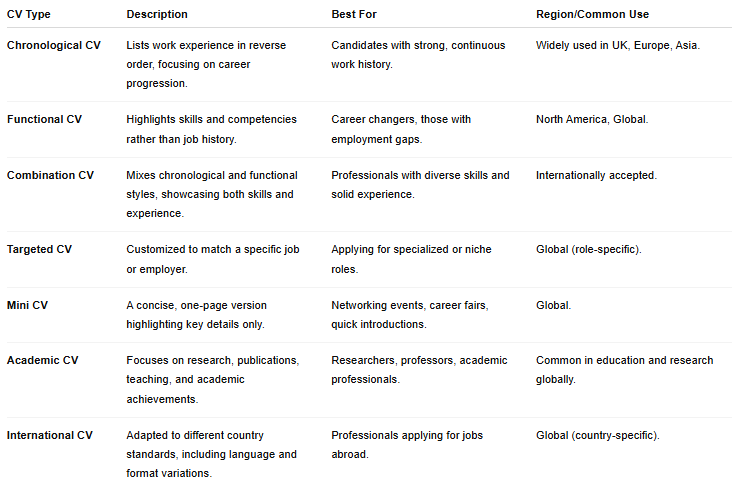
Different industries, regions, and career stages use varying styles to highlight the professional achievements of job seekers. There are different types of CVs, including
- Chronological CV
- Functional (Skills-Based) CV
- Combination CV
- Targeted CV
- Mini CV
- Academic CV
- International CV
Difference between types of CVs
The standards for CV vary from region to region, industry to industry, and job seeker’s qualifications. Different types of CVs are used for various purposes. A single CV can’t serve the purpose for all fields and regions.
What is the Difference between a Curriculum Vitae and an International CV?
The terms Curriculum Vitae and International CV are often used interchangeably, but they have regional differences to consider for job hunters for the ultimate career success. In North America (U.S. and Canada), a Resume is the standard document for most job applications. They use CVs for academic, scientific, and medical fields.
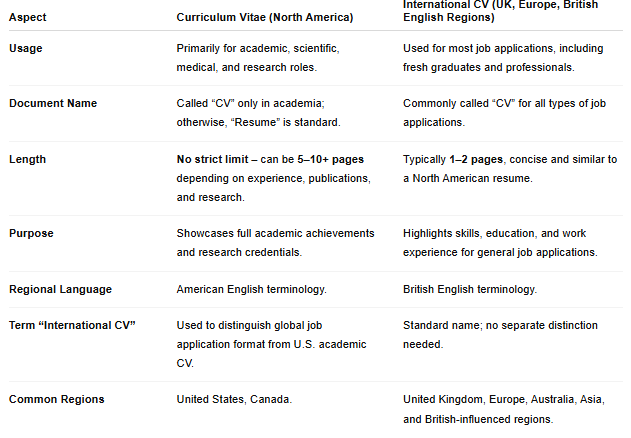
ProTip: To help candidates applying abroad, some career service providers refer to non-academic CVs as “International CVs” to distinguish them from the North American academic CV format.
Things to Add in a CV for North America
In North America, it is not legal for employers or companies to ask for confidential contact details, including marital status, religion, nationality, or other personal details.
- Professional Summary: Just like an international CV, a North American CV’s summary describes the job seeker’s accomplishments and experiences aligned with the requirements of the targeted role.
- Work History: Add entire work history between 15-20 years and rest in the Additional Experience or Career Note section.
- Education Section: Like the International CV, you need to include your entire education with dates, unless it is older than 5 years.
- Research Accomplishments/Grants: You can add these as a separate section.
- Publications: Last Name, First Name, “Article or Submission Title” Journal Title, Journal Volume/Number, Date. For prolific publishers/presenters, it is acceptable to create a “selected publications” section that covers the most recent 20 publications or the last 10 years of publications.
- Patents: Last name, first name [of the inventor]. Year issued. Invention Title. Country Patent #, filed [Month Date, Year] and issued [Month Date, Year.]
- Presentations: Name, “Presentation Title,” Venue/Conference, Date
- Technical / Specialized skills (for example, a computer science PhD likely knows several programming languages)
- Scholastic Activities / Interests (including work/volunteering with their university during their studies and as an alum)
- Community / Volunteer Service
- Professional Affiliations and Memberships
- Awards
- Foreign Language Abilities
ProTip: Creating an Academic CV or North American CV is not an easy task. Don’t waste a potential job opportunity by choosing the wrong format or missing important information required by standards.
What to Call a North American CV in Other Regions?
A CV with 10 pages, or a North American CV used in other regions, is known as an Academic CV. The standards for a North American CV and an Academic CV are the same, but the rules of English differ for each.
In North America, or in regions where U.S. English is the standard, you need to write all career documents in U.S. English. In regions where British English is used, you should write in U.K. English to demonstrate regional expertise.
What is a Resume and How Does It Differ from a CV?
The difference between a CV and a Resume was simple before North America gave a specific name to the document required for academia, research, and medicine. The world was using a Standard Resume where American English was the standard and a Standard CV where British English was the standard.
Below is the complete CV vs Resume comparison.
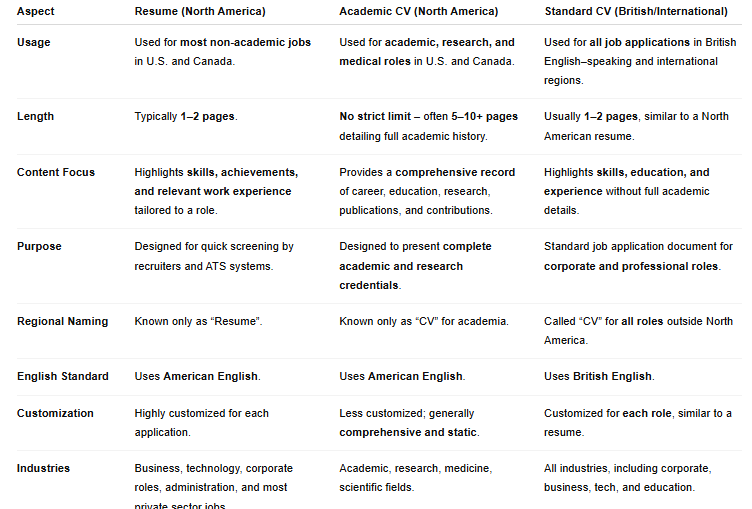
Pro Tip: It’s not about CV vs. Resume. It’s about North America vs. the rest of the world. Still confused? Reach out to ProResumes experts for ultimate guidance.
Conclusion
A CV or Resume isn’t just about the document name and which is better; it’s about knowing the regional writing standards and industry expectations. In North America, ATS-friendly resumes are used for non-academic roles, while a Curriculum Vitae (CV) in the U.S. refers to a detailed academic document for research, medicine, and teaching positions.
Internationally, this academic version is called an Academic CV, while Americans applying abroad for non-academic roles use a Standard CV, and for research roles, they simply use a CV, matching what the rest of the world calls an Academic CV.
To succeed in today’s competitive job market, you must tailor your CV or Resume to match regional norms, career level, and targeted industry standards. A well-structured CV or Resume can be the difference between getting overlooked and landing your dream job.
If you’re unsure which format to use or need help crafting a region-specific document, ProResumes’ certified writers and digital career strategists are here to guide you with expert resources and personalized support.