
How to Match Your Resume With a Job Posting Without Keyword Stuffing
Finding a job should have been easier in a more connected world. There are multiple avenues to explore, from job search websites to social media channels like LinkedIn networking. However, technology has evolved not only for job seekers but also for new-age employers. Due to the Applicant Tracking System (ATS), getting your resume reviewed by potential employers has become a challenge.
An arXiv paper highlights that although automated resume screening systems are now core to hiring, they can exclude qualified candidates. The primary problem appears to lie in keyword-based screening, which can be stopped by algorithmic friction. Another study found that ATS systems can exhibit bias based on real-world patterns. These can include race and ethnicity.
To overcome these roadblocks, a candidate’s resume needs to demonstrate a good fit with the job description. It must do this without keyword stuffing, which can be a huge red flag that increases your chances of getting filtered out.
Understand the Employer’s Language and Translate Your Experience
In a few cases, the difference between your skills and the employer’s requirements lies only in the small nuances of language. This assumes that you genuinely possess the skills and varied experiences the job states.
Suppose you scan through a job posting for a kindergarten teacher. You may find that it demands skills in play-based learning. In your previous workplace, you referred to it as experiential learning. You may be more habituated to using terms like discovery or curiosity, which are closely linked to play for early childhood education.
An insightful study published in the International Journal on Recent and Innovation Trends in Computing and Communication in 2024 highlights that many newer matching systems don’t rely only on exact keyword overlap. Instead, they use semantic analysis and pattern recognition. This means you will be well-placed if your strengths broadly connect with what an organization is seeking.
Try scanning the job profile for key elements, such as the required skills and tools. Adapt your resume accordingly, without resorting to copying everything.
Here are some ideas to help.
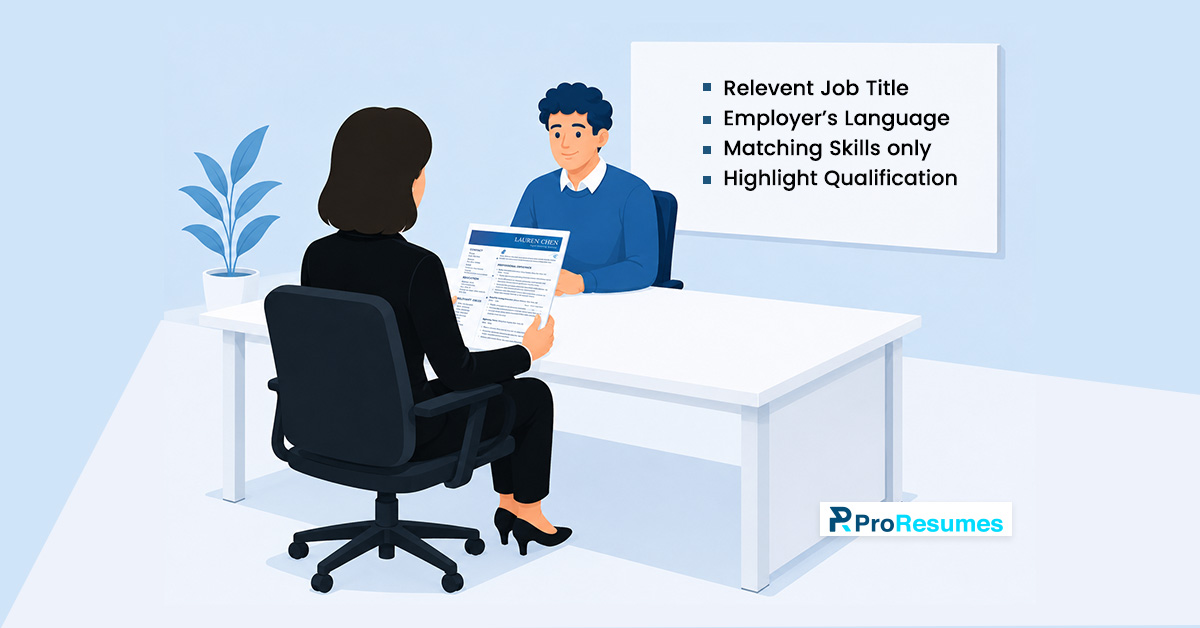
| Element of JD | Adapted Language | Example |
| Job Title | Use a relevant professional title that reflects your total years of experience, industry, and specialization | Content Specialist with 5 years of experience working with finance clients |
| Key Responsibilities | Rewrite using the employer’s terms | Collaborated with interdepartmental teams to find employee grievances as part of an HR feedback program |
| Required Skills | Add matching skills only when you have supporting experience | Developed AI-assisted media for internal projects, lowering design turnaround time by 20% |
| Qualifications | Highlight relevant education and certifications | Bachelor’s degree in Nursing with a certification in mental health |
| Tools | Include the exact tool names the employer has used | Worked with Claude and Gemini to improve debugging workflows |
| Skills like problem-solving and communication | Add achievement-based examples | Presented campaign insights to leadership for finalizing the quarterly content strategy |
Emphasize Transferable Competencies
For those of us transitioning to an altogether new career, the mismatch between our current skill set and job demands may seem stark. The urge to engage in keyword stuffing may be high, for how else will you get noticed among so many more qualified professionals?
This line of thinking can prove detrimental to your likelihood of getting the job. Most scanners frown at keyword stuffing.
Instead, match your resume with the JD based on the academic learning you have gathered for the new career and transferable skills from your existing professional repertoire.
For example, consider the healthcare sector. Some aspiring nurses with unrelated degrees decide to pursue an ABSN program online to become a practising registered nurse faster. When applying for job opportunities, such professionals should emphasize their transferable skills. They should also explain how the relevant academic learning strengthened them.
As Cleveland State University notes, such accelerated programs encourage aspirants to develop real-world competencies in multiple areas. These can range from pharmacology to research. If you have previously worked as a research assistant or technical writer, you can highlight skills like attention to detail and documentation.
Commit to the exercise of recognizing which skills will be deemed valuable by a recruiter. As a well-being technology expert shares in a Psychology Today feature:
“The ability to recognize which of your skills may serve you well in a new situation is itself a skill. And recognizing which of your skills are transferable and what new skills you may need to pursue may be the most valuable transferable skill of all.” – Tchiki Davis, Ph.D.
Highlight Job Readiness if You’re a Fresher
Suppose you feel you’re a strong candidate for a posting. The problem is that your CV lacks depth because you’re just starting.
More companies are now open to hiring freshers with potential and an eagerness to learn. And yet, ATS systems may block resumes that don’t noticeably align with the requirements.
Again, the point is not to add experiences or competencies you don’t legitimately possess. Doing that will mean you get filtered out a tad later and also get stuck with memories of mortifying interviews. Instead, build a profile that exhibits your job readiness.
A 2024 research paper published in Education + Training showed that employers value holistic competencies. These are strengths you develop in college through work placements and extracurricular activities. For graduates, these work as signals of job readiness.
Another component that can score you an interview is adding a digital portfolio that supports the competencies you’ve showcased in your resume.
For example, say you’re applying for the role of a coder in a tech firm. The job description may say that candidates should understand application development in its entirety. You can demonstrate this by sharing instances from an end-to-end project you completed in college. Also, include the details in your portfolio for the recruiters to explore.
Similarly, you can add examples of campaign projects you have completed if you are applying for a marketing position. The example can show how you combined content strategy and analytics.
From Missed Avenues to Learning to Succeed
Learn to tailor your resume for ATS without cheating. Not having your application shortlisted for a position you aspired to is disappointing without any doubt. However, considering these failures as learning opportunities can help you secure an interview sooner than you expect.
The limitations might not be in your capacity, job experience, or lack of it. It lies in a resume that feels misaligned with what the recruiter values. The keyword stuffing might pass the automated scans but will eventually fail during the recruiter’s screening.
Assessing the possible areas for improvement in your CV or resume can strengthen it for future applications. It will also reveal unknown knowledge and expertise gaps that you should invest in for skill-building. You can easily overcome this through help from self-directed learning, professional courses, resume optimization guidance, or exploring professional resume services.
FAQs
How can I identify important keywords in a job posting?
The key is to find repeated skills, requirements, tools, and responsibilities. The posting may have industry-specific terms and desired outcomes. While aligning your CV, prioritize terms that appear multiple times or are highlighted as required.
Should I build a separate resume for each job application?
That may be best. You don’t have to rewrite everything completely, but you should align the key parts, including the summary and necessary skills. Your experience may also need modifications. These areas must reflect the requirements of each job posting you pursue.
Can I include skills that I learned from a course or project?
You can include a skill only if you have genuinely practiced it. While you can add skills you developed in an academic or project context, ensure that the context is clear. It can be a mistake to imply professional experience if you do not really have it.